Showing posts with label research. Show all posts

Monday, June 1, 2026

Is social becoming less enterprising and more charitable?

Some people may know that I like both data and legal forms (amongst other things). I can play with both in isolation, but I particularly like combining the two because of the new insights it can offer us.

Each year I try to check in with the respective regulatory bodies who oversee the principal legal forms in use in the social economy (Charities, CICs, Companies, and Co-operative Societies), to skim through their annual reports and pull out the latest numbers on formations and dissolutions.


changing trends in who's registering what form

I share visual charts of these numbers in workshops I deliver on legal forms - not to try and influence people's choices about what they should 'be', but to offer an additional and alternative perspective that can help prompt more critical thoughts and questions so that they can ultimately be more comfortable and confident in whatever they end up being. I've been tracking this data since 2017 (nearly 10 years), and this years' spreadsheets highlight:

  • the long-term trend for 'sustainability' (how likely you are to be wound up based on your legal form) shows CICs and Companies remaining roughly equal with about 12% of each being de-registered each year. This compares to charities and co-operative societies that are wound up at 3% each.
  • But what's seemed to 'jump out' this year is the figures for 2025 compared to the previous trends: new CICs have been registered at a rate that's 20% higher compared to 2024, with no change in companies, (and a halving of the rate at which new co-operative societies have been registered). But the registration of new charities was double what it was in the previous year.

Which means if we're using legal forms as a proxy indicator (of sorts) to understand what social enterprises and social entrepreneurs are experiencing in their business models, this seems to suggest that there's a growing difficulty in their generating traded revenue (hence the static or reduction in the growth of 2 of the 3 legal forms that are designed to encourage trade), and a growing need for financial support in the form of maximising eligibility for grants and reducing tax liabilities (based on the doubling of new charities being registered).


less faith in the social enterprise model?

Most of us in the sector are aware of it being the worst time in living memory with regards to being successful in grant funding applications, but with wider economic pressures that we've seen growing over the last year, are we starting to also see the trading models that new social enterprises are considering reflecting this pessimism in marketplaces too? 


As always, I don't post and share these notes as a definitive position, but to offer perspectives that may hopefully help us have better conversations - and better conversations can help us create better impact (and can also include me changing my mind, as I have in the past!). 


Tuesday, December 23, 2025

missing the mark? what the latest research about social enterprises suggests about those who support them.

At the end of each year, most people get excited about what's behind the next door of their advent calendar, or the prospect of up to 4 weeks to indulge in unlimited mince pies.

Not me.

I look forward to the bi-annual state of the (social enterprise) sector research, that's published by Social Enterprise UK which is also released at this time of year.
(But I do also love mince pies...)

And that's because I'm always interested in what data tells us about what's really being experienced within the sector by those doing it, rather than the rhetoric of policy makers, infrastructure bodies, and people who speak about the sector - and yes, being led by the data and research does frequently see me being put in the naughty corner for the upset it can cause to other bodies because it can sometimes contradict their narratives and positions...

But to be clear: I never intentionally try to embarrass anyone publicly, but have an idea that if someone is going to be making decisions that affect their enterprise and personal future (and that of their family and wider community by association) then surely we should be offering the best-informed insights and options, because it's they who'll have to live with the consequences of those choices, not us?


So - to this latest research and what I'm reading from it (although other interpretations may be, and are, available: please check out the report yourself and draw your own conclusions): Backbone of Britain - State of Social Enterprise 2025;
and as with all research, remember to approach with caution: large data sets like these only reflect the 'main middle' - there will always be exceptional stuff happening around the edges...


the sector is very unequal
Roughly half of all social enterprises are below the VAT threshold by turnover (currently £90,000), yet their average number of employees is reported as being 6. Assuming that people aren't being employed on a 1-day week basis (the only way you could get these 2 numbers to line up), this suggest a sector that is made up of a lot of small social enterprises, with a disproportionate influence of a few very large ones on the overall picture we're being presented with.


legal structure choices and experiences continue to throw up surprises
The number of CICs in the sector appears to be starting to 'flat-line' over time (which is in keeping with longer-term trends about the numbers of CICs from the CIC Regulator), in contrast with Companies Limited by Guarantee (the most commonly used, and favourite choice for social enterprises for over half a century, before the CIC was proposed by government).

This contrast between CIC and CLG isn't constrained to their seeming popularity - CLGs are also reported as typically generating higher incomes than CICs.

But the historical OG of all legal forms continues to outpace all other choices when it comes to how large their turnovers typically are - co-op societies aren't going anywhere soon (which is also reflected in their having a far lower wind-up rate than both CICs and CLGs).


an increasingly weak financial position and outlook 
fewer social enterprises are reporting being able to generate profit, with nearly half now only able to achieve a financial break-even. But this seems to be galvanising social enterprises to focus more on making sure they're getting the most of what cash they are generating:

-  1 in 3 of all social enterprises seeking support say it's in relation to strengthening their financial management;

- there's a reducing trend of how far social enterprises are able to invest in training and development for their teams;

- there's a significant increase in social enterprises seeking support around the topic of redundancy, suggesting a sector that's starting to recognise the need to make hard choices about its future.


most social enterprise trading models remain in avoidance of delivering  public services
In keeping with historical trends, the main customer type of all social enterprises isn't the public sector to deliver contracts on behalf of, but us, the general public - only 1 in 5 social enterprises base their business model on delivering public sector contracts, and 2/3 have never engaged in this type of activity. 

But for those that do, 1/3 report struggling to engage with procurement processes and systems - suggesting still more needs to be done to level the playing field, despite 20 years of national campaigns, programmes, initiatives, and lobbying by different sector bodies.


social investment offers are increasingly out of touch with the sector?
There's a growing trend of social enterprises saying that social investment offers are too expensive and/or not designed to offer them what they need, with a growth in high street banks being turned to for finance instead.

But there's also a weaking of the wider sectors' ability to raise investment in general: the typical amounts being sought to be raised, and the likelihood of success in doing so, both continue to fall...


a determined sector, nonetheless
But in the face of the above, the social enterprise sector appears to be doggedly resilient and sheer bloody minded about finding ways to keep going:

- where investment is being sought, it's for stuff like buildings and equipment, showing a long-term strategic planning focus, rather than looking for 'quick fixes';

- similarly, the topics that make up the top 1/3 of all requests for support relate to strengthening systems for the long-term, rather than 'quick wins': governance, leadership, impact, and accessing training opportunities;

- and while the development of new offers and services continues to be the main way in which most social enterprises are seeking growth, that they're doing it with less investment shows 'frugal innovation' at work (pointing to a high degree of resilience and adaptability; although 1 in 5 also say that their ability to grow and adapt in these ways in being hampered by a lack of suitable, accessible, or appropriate support for them).


So overall, it initially looks concerning (although with some signs for hope) - but we should never read research in isolation: looking at comparable trends for both traditional charities, and private businesses, shows these themes are being similarly felt there (and usually to a more painful extent!).

And if this reflection seems overly critical, then maybe it is - but as a sector, social enterprise has huge potential if it can only plug into the right things. And from this latest mapping, it might seem that some of the things which were created to do just this for the sector may be starting to struggle to keep up with what's needed from them?

Thursday, September 11, 2025

why unpaid carers struggle so much to be heard...

I think I've figured out why it's so difficult for the views and experiences of unpaid carers to be accepted by policy makers and government.


Along with a few million other people in the UK, I'm an unpaid carer - and I'm also self-employed; juggling earning a living alongside meeting the support needs of several immediate family members.

Over the last few years, I've been trying to wave a flag for those of us like me - because we're the only type of unpaid carer not currently recognised in law or policy (which means there's no support for us). This lack of support is also a problem for everyone else, because it means that our respective businesses are all under-performing: in the wider economy there's over £10Billion of lost/deferred job creation, investment, exporting, etc that isn't happening every year, because we're trying to figure how to support ourselves in reconciling these competing roles on our own.

A key way in which I've been able to have some small initial successes in attracting interest to the approaching 1million people / unpaid carers / small business owners who are in this circumstance is through research and data - without which, policy makers and membership bodies can't justify investing the time to investigate these issues more.

But recently, a comment by one of Directors at the Centre for Local Economic Strategies (CLES) gave me reason to go back to basics with this - I'd referenced in conversation that most unpaid carers are just as likely to be men as they are women (in contrast to the typical general perception that it's usually women who take on caring roles). They challenged this by referencing the latest national census return, which CLES use as a baseline for all their policy work, as showing that it's actually predominately women who are unpaid carers. 

So I went back to the original source materials and realised that all the national government, health, policy, and support bodies are all working to a different understanding of who we are as unpaid carers.


It's shocking and depressing in equal measure - they all have different data about who unpaid carers are, and are using to base their support to us on. Is it any wonder then, that there's so much confusion about us, and why it's so hard for our voices to be heard? Because without a common agreement on how many of us are men, women, or other, each public body or agency can easily dismiss the research of others', on the basis that the starting point of identifying and understanding who carers are at such a fundamental level is so different to their own.


Can you see the confusion in the above chart?
  • The government census shows a roughly 60/40 split in gender - but this survey was done in a global pandemic, and there's been questions subsequently raised by others about the validity of this finding, because of how the question on the census from was worded which likely led to many people not identifying themselves as carers when actually they are;
  • Another government source (the DWP's family resources survey) has a different split at 66/33;
  • x2 national public health sources (the national GP patients survey, and a national NHS survey) both have a big difference between them in how they've identified the gender split of unpaid carers;
  • and the research by national bodies are who specifically created to understand and support carers have a notably different split again, at 50/50.
And this initial basic question of gender is also excluding people who don't identify along such binary f/m lines. 


So - if all the government bodies and statutory health services can't agree on such a simple basic starting point of 'what's the gender of unpaid carers?', then is it any wonder why carers are so mis-understood when it comes to us trying to share our experiences, or lobby for changes that would see us getting closer to being afforded the same recognitions as everyone who doesn't have caring responsibilities?


As for me - I've always generally aligned with the maxim "nothing about us without us". In this instance, that means I'm currently more trusting of data from carer support bodies, rather than distant civil servants whose own internal governmental departments and bodies can't agree on how far we may be made up of more than one gender than the other.


Thursday, October 24, 2024

why cowbells, 3-year olds, and punching bags are a better way to create social enterprise policy

"We need to get more experimental with creating national policy" - is the encouraging takeaway I took from my recently being part of the global Social Enterprise World Forum Policy Forum event.

Showcasing a range of insights and experiences from around the world, the Forum offered a rare opportunity for people within all parts of the wider social enterprise ecosystem (from start-up social entrepreneurs, to global policy managers in the UN), who wouldn't normally be able to meet each other to question, challenge, encourage, and inspire in ways that don't usually happen.

It was also far from what some might have expected in terms of how research was shared, ideas provoked, and people engaged, as the title of this blog post suggests!


Listening to the debates; reflecting with others in the speed networking slots; (and yes, for those of you who know me, I was also doing lots in the chats of each session I joined); it struck me that a lot of policy we've seen in the UK over the last 20-30 may actually not have been that great for the impacts they've created.

Sharing stories through the conversations made me realise/re-enforced my ideas that:

- the reason we have an apparent glut of social investment that most lenders are struggling to 'get out', is because it was a government policy agenda that said it would be a 'magic bullet' that the sector needed (but with little research or evidence to substantiate this)?

- it was also government policy that gave us the Community Interest Company (CIC), at a time when it admitted that the wider sector had no stated need or appetite for any new legal forms. It also created them in a way that simply 're-badged' various existing company features as something 'new and unique'. Perhaps this the is reason why CICs seem to have always struggled to have more longevity than regular private businesses, and are usually more reliant on grants than charities are?

- and those early policy agendas also drove the impetus for social enterprises to be delivering public sector contracts: yet the researches that have been published in subsequent years point to most social enterprises not using this as a mainstay of how they trade, and for those that do, they often do so at a trading loss?

But despite this, having had separate policies as we have, has meant the profile and awareness of the concept of social enterprise is higher than it might have otherwise been.


However... I was also reminded as I traded stories with others in the Forum, that most of the research about the specific needs of social enterprises shows that they have more in common with private businesses than not - and in the very early days of the explosion of interest and activity around social enterprise (at the turn of the millennium), it was 'regular' business support bodies and services, and the policies that informed them, that sought to integrate the majority of support for this 'new' sector.

There was subsequently a 'parting', but now, 20-ish years on, I'm starting to see some signs that there's thought and interest in exploring how they might be re-integrated (through the likes of Growth Hubs, Shared Prosperity Fund programmes, etc). 

And perhaps this emerging possible refocussing of policy is coming about because we've now had sufficient time to understand the impact of these early policies? As one of the key speakers suggested, "it can take at least 5-10 years to understand the impact and effects of a policy, so we need to treat them as more experimental". In those early days of social enterprise, there was scant data to base policies on, in comparison to what we now know and understand - so maybe policy makers need to start being braver in resetting the paradigms that they're working with? 


However, creating such a shift will take time and effort - and for those making the policies, represents a scaring foraying into new unknowns.

Maybe the best way we can be part of bringing this change about, was an idea shared that social enterprises might best create influence amongst policy makers by 'stealth': offering and asking to engage in staff secondment schemes, so that those informing the design of future infrastructure get first-hand experience of the realities of how it would be likely to be actually experienced by those it's intended to benefit. This may not be the usual 'showy' way that we're encouraged to try and lobby and advocate (with huge petitions, and PR stunts), but reminds us that everyone in the wider (eco)systems are ultimately human beings, and we can best get things done by engaging and building relationships with each other as such.


For more reflections on the Forum, see - https://sewfonline.com/empowering-rural-communities-and-youth-sewf-policy-forum-highlights/ 


Sunday, September 22, 2024

how desperate unpaid carers really are...

Carers UK recently published research into how many unpaid carers are in poverty (spoiler: being a carer means you're x2 as likely to be in poverty than if you're not).

Despite being lauded by government and other agencies in recognition of the roughly £160 BILLION that we save the government EACH YEAR, there's still plenty of disgruntlement amongst us for the lack or recognition and support we receive in turn - for example: for those eligible to qualify to be able to apply for carers allowance (plot twist: despite having sole unpaid caring responsibilities for several family members in my immediate household, I'm only eligible to receive £6 each week), this only offers about £2 per hour that we can receive in recognition of the time we spend caring, which prevents for from being 'economically active' otherwise: earning money to support ourselves as others can. For comparison, the legal minimum wage we would have to be paid for any job, however menial, starts at £6.40 per hour.

The report by Carers UK digs into this topic in painful and shocking detail. And while others have done far better jobs that I in looking at the wider dimensions of how carers suffer inescapable poverty because of the nature of the role: https://numbereighteeninthecorner.blog/2024/09/19/carer-servitude/, - I'm focussing here on what this latest research tells us about how being an unpaid carer affects those of us who are also self-employed. 


Now, before we get into Carers UK's research, to 'set the scene' here, self-employment in general is:

And yet roughly 500,000 of us who are unpaid carers are choosing this way of working on top of being a carer, which in itself is recognised as being:
  • highly stressful;
  • leaves us socially isolated;
  • bad for our mental well-being;
  • roughly, up to £20,000 worse off EACH YEAR. 


So lets do the reveal: unpaid carers who are also self-employed are x2 more likely to be in poverty than their employed counterparts, who also have caring responsibilities (and to 'rub salt in the wound', we don't get the same legal recognition or protection as they do...

chart showing how carers who are self-employed are twice as likely to be in poverty than carers who are employed

So why are so many of us pursuing this apparent nonsense of pushing ourselves even further 'over the edge' by 'doing' self-employment alongside our caring role, when all the evidence above says it's the worst thing anyone could do to themselves?


As Carers UK research highlights, nearly half of people who were salaried before becoming carers are forced to give up their jobs, because they find the two roles aren't compatible. 

The current rules on carers allowances (assuming you're eligible to be able to be apply for it, then and lucky enough to get it) means that you can't earn more than £151 a week. Combined with the max carers allowance of £81.90, this would mean you have a maximum income potential of roughly £12,000 a year to live (covering housing, food, utilities, clothing, etc). That's less than half of what's recognised as a person needing to earn in order to have a minimum acceptable standard of livingThis means that many carers simply can't afford to apply for/live on carers allowance, and as previously highlighted, quite a lot of demands and requirements of being an employee are incompatible with being a carer.

Which means that short of picking the winning numbers on the lottery, or robbing a bank, the only other choice is either living in deep poverty or doing self-employment (although as the research shows, doing self-employment is no guarantee you won't escape the poverty trap).

And I've also heard of some of my contemporaries in this space who've openly shared that taking on this most stressful of all employments was the best way they could find to help them find a counter-balance to the stresses and responsibilities of being a carer. Which takes us back to the earlier point of how tough being a carer is - but how tough must it be, for the most stressful of all employments to be seen as a type of respite from it?  


So for anyone out there who's also a carer as well as being self-employed: I hope you take some comfort from this post, in it offering you a recognition of how tough life really is for you. And for anyone who isn't: I hope you can use some of the feelings that this post has (hopefully) stirred up in you to act in support for carers of all types. 

Thursday, September 5, 2024

how better support for carers could instantly see growth in 20% of businesses across the economy

I've written in the past about how unpaid carers are usually invisible and overlooked, and that for those of us who are also self-employed, we're even more so, because we're not even recognised in law (unlike our counterparts who may be in salaried employment, and despite there being an equal likelihood that if you are able to work while also an unpaid carer, you'll be doing it in this way).

I've also shared the statistics about how this lack of support for those of us who are (trying to) trade and maintain caring roles, means that 'UK plc' is at least £5billion a year worse off than it might otherwise be.

But I've recently also started to have conversations with some different local business support bodies', and start-up programme, managers who are beginning to recognise that they perhaps aren't doing anything/enough to consider the design of their offers and encouragements with regards to the circumstances and realities of people with caring responsibilities.

This came to the fore for me recently, as part of an event organised by the Collective Leadership Group, who'd invited me to showcase some of my research and efforts around the realities of being an unpaid carers and an entrepreneur.

As part of this event, Hatch Enterprise shared the findings of a recent study that they'd undertaken into the experiences and barriers people face in relation to the concept and idea of entrepreneurship. One of their question prompts from their surveys in this was about barriers entrepreneurs were experiencing that were hindering and limiting the success of their respective ventures. As well as questions around gender, geography, ethnicity, and disability (which remain depressingly entrenched), their survey also asked about caring responsibilities:

chart showing 21% of women and 18% of men find having a caring responsibility acts as a barrier to the success of their business

For me, this is an exciting chart, because it highlights and challenges:

1) the extent to which all existing businesses are being constrained, because of a lack of relevant and appropriately designed support available to them by business support providers and caring bodies;

2) that there's near parity in how men and women are affected - caring is usually associated with women, but as I've been seeing over the last few years, there's far more men doing it than might be otherwise expected.


The wider session was also encouraging, as as I shared my notes and ideas based on the research and evidences I'm identifying around this topic, people agreed that there's a lot of 'blindness' to not only how carers are thought about (or not) when programmes and projects to support different groups of people and communities and being designed and run; but also to the very limited and outdated stereotypes about the scope and range of understanding that most people have in relation to what caring roles can look like and involve, and who has them.


Friday, June 14, 2024

the internet seems to keep loving my ideas about business plans!

I've always been open about encouraging people NOT to write business plans - mainly because all too often I meet entrepreneurs who've spent hours and days creating them, not enjoying the process, and crucially not really understanding why they were doing it... (it seems many 'professional' business advisers don't take the time to check that what they're telling you to do is actually the best thing for you to do...https://youtu.be/ZpPYqBlt1Ek).

In my experience, most people don't enjoy the process of writing them, and those that have then never actually ever go back to them (they languish in a drawer or a forgotten folder on their laptop).

And there are various research studies that have been published which also find that in most cases, the difference that having a formally written up business plan has on the success of a business is as good as negligible (i.e. no proven benefit). Although interestingly, these studies also find that those who do write plans usually only do so because someone else (a lecturer at College, or business adviser) told them to... What makes the difference on a businesses' success is that they go through some from of planning process (so using a canvas, or set of prompts to think things through, rather than just rush headlong into it all).

Which means that whenever I'm asked to lead workshops, masterclasses, or other sessions aimed at supporting people to develop their business plan, I always open with the critical question "why are you wasting your time writing a business plan, rather than going out and talking to customers or suppliers?".

And I'm encouraged, that when I originally wrote up these ideas on my blog back in 2010, this piece seems to be my most 'evergreen' post: it's not only one of my most popular ever posts by number of views, but also keeps being found and read by people - 

Of interest is that these 'spikes' in interest usually align with the start of a calendar year - the time people are apparently most likely to be thinking about starting their own business, and so searching for inspiration and support for how they might best achieve that dream.


And what this also suggests to me, is that I'm starting to get more interested in the analytics about my blog that I once decried...

Which means that having already started to consider how analytics from my social media channels can offer benefit in helping me understand how I'm creating benefit (as reported in my social impact report on myself), I'm now also starting to look at how the analytics on my blog over time can also offer further insights into my reach and support to other people that I'm not otherwise aware of...  

Monday, April 1, 2024

CIC 2.0?

Nearly 20 years ago, the Community Interest Company (CIC) form was introduced to high acclaim and interest for the social economy sector.

Since then, it seems to have struggled to fulfil its potential, based on various datasets which has shown it to: 

And my poking around different data sets in these ways as shared in my blog here, has led me to be invited to write features for both Pioneers Post, and Stir to Action in recent years.


But I've spotted something recently about CICs in the data about them that makes me wonder if we're about to see a change in how this part of the social economy acts.

One of the data sets I regularly look up are those published by the CIC Regulator (along with those published by the regulators of the other legal forms: Companies House, the Charity Commission, and the FCA). And recently, the CIC Regulator has started reporting on how many of the new CICs that are appearing each year aren't 'new', but are actually existing limited companies who have decided to convert to a CIC.

Over the last 2 years, 50% (yes, half!) of all CICs added to the register have come through this route of an existing private company converting to a CIC.

Frustratingly, it's not clear what the motivations are behind these companies wanting to make the shift to gain a legal status that doesn't offer them anything that they couldn't already have otherwise incorporated within their legal form more easily, and which isn't automatically helping them access any new grant funding opportunities.

But these new data points suggest something seismic may be starting to take place amongst the CIC community - without this rise in interest from already established private companies, the growth in CICs would be in single % figures each year (lower than private companies), rather than the current roughly 20% growth. This means that CICs as a whole are likely to be starting to be increasingly influenced by the practices and thinking of previously private companies - rather than the historic basis of wider local communities applying for this form. 

What this means for how CICs will start to be viewed by the wider sector and others remains to be seen, but with a growing number of CICs being registered that don't have their origin story in how this part of the social enterprise sector has worked for the last 20 years, must surely mean that if this trend continues, we may be seeing the start of CIC 2.0?

Thursday, February 8, 2024

why some people don't want to banish their imposter syndrome

Some people will be aware that I wrote a book about imposter syndrome, which turns out to be a bit like marmite: some love it, whilst others have uninvited me from speaking at events because of it.

The central idea in my book is that, after looking at lots of research papers and studies, and evidences from various places and sources, I don't think imposter syndrome is what most people say and think it is. 

(SPOILER - it's actually part of what it means to be a human being, helps keep us safe, and can act as a superpower in our work and lives).


But something that struck me as I waded through all the published research materials about it was a recurring thought: 'if all the evidence and research keeps showing this thing isn't what people say it is, then why does it seem that so people say they feel they have it, and it's negatively affecting their lives?'


Perhaps part of the answer could be that imposter syndrome is an illusionary truth - something that, because we've heard lots of people talk about it in the same way, we accept as being true without questioning it. Just like the 10,000 hours rule, breakfast being the most important meal of the day, etc. 

But I also wonder if it may also be to do with it being a 'label' which, in being external to a person, makes it easier to validate a lack of motivation or desire to progress on their part? (And so we fall victim to a self-fulfilling prophecy - best articulated in the armed forces through their adage of 'if a soldier thinks they'll die in battle tomorrow, they'll probably find a way to make it happen'.)


Suffering with 'something' can make it easier to justify not pushing ourselves to grow - but in doing so, we create a fake 'safe space' for ourselves, which only serves to limit our potential, and the lives we might otherwise be living.

As Baz Luhrmann once observed - "a life lived in fear, is a life half lived."

Thursday, November 2, 2023

merging not closing - the future of charities?

Regular readers of my blog will know that I enjoy analysing a good data set - and trying to turn them into simple charts that usually make everyone who seems them stop in their tracks and start to rethink what they thought they understood and knew.

Well, it's time for another 'pause and wonder' moment, as I turn my spreadsheets' gaze on charity mergers...

In the past I've looked at data on the 'churn rate' of charities (how many are being wound up each year, and also in comparison to the extent to which other legal forms are being wound up) - but recently, I came across the register of every charity merger since the end of 2007!

Now, despite my having been involved in 'refereeing' some mergers between charities in the past, it's always felt to me that there's something of a taboo about charities merging - Trustees don't usually seem that comfortable wanting to talk about it (unless their charity is in immediate threat of going bankrupt), by which point any other charities doesn't want to entertain taking it on as a liability which would drain and distract from their existing resources. Perhaps this is why about 3% of all charities are wound up each year in comparison to the 0.2% who merge. Does the variance in these figures suggest that charities are finding it easier to wind up, rather than be able to successfully merge with another charity?

This hypothesis, coupled with the time that a merger between charities can take (6-12 months if you want to do it properly?), seems to suggest that merging as a means for a charity to continue to see its purposes achieved beyond it's own existence is usually not taken up or enacted, even if it may transpire to be the best choice: Trustees are simply leaving things too late in the hope that something will magically resolve before feeling they can start talks with other charities about a merger option while there's still plenty of time (and reserves) to do things calming and in a less risky way.


But what of this 16-year data set about charity mergers I teased you with at the start?

Well, here's the chart:


And to help you make sense of the squiggles in it 

  • the blue line shows the number of charity mergers happening each year. Interestingly, these started to significantly increase in the years BEFORE the Covid pandemic, and have now started to drop, even during the cost of living crisis. This suggests that massive financial shocks to the sector are not having any influence on charities exploring merging.
  • the orange line shows the average number of mergers each year over the last 16 years. 
  • the dotted line is the next one of interest: it shows the linear trend of charity mergers over the last 16 years - admittedly, it's rising very slowly, but it's rising nonetheless, which suggests that ever so slowly, more charities are starting to pursue the merger option to best safeguard their purposes and support for their communities. For example - in the period 2016-2022, the likelihood a charity would merge increased by roughly 75%, in comparison with the likelihood a charity would be wound up increasing by approximately 10%. 

But is it too little too late?

We're still seeing only 0.2% of all charities completing a merger each year in comparison to the far larger 3% who are wound up.


Perhaps this chart and the notes below it will help more Trustees start to explore the merger option sooner rather than later, and so better protect the people they were originally set up to support?  And if they do, could this see a flipping of the current numbers, so that in the future, more charities merge than are wound up?

Wednesday, August 16, 2023

how to (instantly) lose credibility as a key-note speaker

We've all been to conferences, webinars, and other events where there are headline speakers presented to us in a fanfare of excitement - and we all find ourselves getting whipped up in anticipation of what they're going to say, and then as they're delivering their message/story/challenge, we find ourselves moved to start to take action and make changes in our lives and businesses.

But what if the changes we make because of what these big name people exhort us to, are actually based on lies, and these high-ticket speakers are actually misleading us?


In the last few months, I've been at events where some of the 'big names' touted as to why I should attend them have based their whole arguments on different un-truths, including:

1) it takes 10,000 hours to become an expert in something

2) according to the laws of physics, bees shouldn't be able to fly

And if you're reading this thinking - but those things are true, please ask yourself this: how do you know they're true? Chances are, you believe them because you've heard them repeated by lots of people over time. (This is know as 'the illusionary truth effect'.) I'm pretty sure, you won't haven't researched either for accuracy or published research, because you already believe them to be true so, don't need to fact-check them.


My concern about this perpetuating of un-truths as part of people supporting their ideas or arguments, that they want us to act on is this:

- If you're asking me to believe the ideas you're presenting to me, but the foundations that you're building them on simply aren't true, then:

a) you've shown you can't be bothered to do some simple homework / fact-checking, which makes me wonder what else in your approach is similarly 'lazy'?

b) if you're asking me to trust you by relying on things that have been proven to be untrue, then that's a hard ask...


Reflecting on my own experiences and feelings of when key-note speakers have 'shown themselves up' in this way, I find myself immediately 'switching off' to want to listen to anything else that they're wanting to offer and argue - because I simply feel I can't trust it, and that they obviously don't have any respect for me as their audience. 

Which is a shame, as I also realise I may be missing out on some good stuff that's buried amongst the fallacies and untruths that they're unwittingly perpetuating, which only serves to contribute to false understanding about what we and others might really be capable of... 


So please - any of you out there who are speakers or headline attractions at events: do us the courtesy of showing that you respect us as your audience and fellow human beings, and do a quick check of your facts before you unwittingly succumb to the illusionary truth effect, and tell us do things based on 'facts' that just aren't true (and never have been).


debunking the 10,000 hours rule - 
https://www.6seconds.org/2022/06/20/10000-hour-rule/ 

debunking that bumble bees shouldn't be able to fly - https://www.todayifoundout.com/index.php/2013/08/bumblebee-flight-does-not-violate-the-laws-of-physics 


Wednesday, April 13, 2022

social enterprise legal structures for humans

Some people regard me as an expert authority on legal and governance forms for social enterprise, community businesses, and co-operatives - and while I always encourage people not to trust any guidance I offer them on this topic (because I'm not academically accredited in legal stuff, and more importantly because I'm not the one who's going to be legally responsible for administering the chosen form), people take encouragement from my achievements in changing company law, navigating Society Rules with the FCA, and finding paths through charity legislation.

Over the decades that I've been supporting people understand these choices, I've created a few tools/prompts to help focus discussions and reflections ('CHAMP' and 'Adrian's 4-boxes') - but this post isn't about those tools - instead it's about a 3-part limited youtube series I was invited to be part of the 'main cast' for.


A contact through one of my networks had approached me to ask if I could help them explore and understand what the best legal form for a new social enterprise they were developing might be. And as we talked about how I might offer guidance and assistance, we hit on the idea of making this a 'performance piece' - drawing back the curtain on how people usually go through this process as an encouragement to the wider sector, and also a working out of some of their (and the emerging enterprises') values.
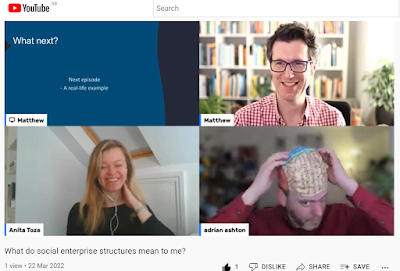
So we scheduled 3 afternoons to talk though approaches to not only understanding why this legal form question is so important to get right, but the different ways we can pick and choose between them, and finally, applying all of this learning in real time/live to their nascent social enterprise.

There's an 'official' long post on LinkedIn by Matthew Bellringer (the contact that sparked this) where you can get the official story of how this series came to be: https://www.linkedin.com/pulse/foundations-thriving-social-enterprise-matthew-bellringer/ but I wanted to take the opportunity to reflect on how I found this process, in it being different to the ways in which I usually offer this type of support - to pull out what surprised me that I hadn't considered before, what was an encouragement in allowing more time and space to explore than is usually available, and some of the things which you don't normally hear or read about in this area.


So - the below points are what I think are useful framing/warm-up for anyone thinking of approaching either choosing or reviewing a legal or structural form for their social enterprise - if you want to know more about them, you'll have to follow the links to youtube and watch all 3 episodes...

- Comparing legal structures to buying second-hand car: you wouldn't buy a car without wanting to know some of its history to assure you that it's been built well, and looked after, so why don't we seek the same assurances when deciding between legal forms?

- The risks of using data that maps legal forms used by social enterprise in helping us choose one for our own: as part of the episodes, we looked at research into how far different legal forms are popular/less popular by the wider social enterprise sector. But as you'll see as you watch this segment, this mapping - as undertaken by national sector bodies, often presents a contradictory picture of findings. As with all research, what you find depends on how you ask the question, and whom you ask it of. And it seems that our sector leaders can sometimes do this in ways that might not seem to be that robust..?  

- None of the existing tools designed to help you plan your social enterprise model (social enterprise canvases, specialist business plan templates, etc) help you relate your ethos and values to the legal form you'll pick. Which seems a bit bonkers, because your chosen legal form is probably one of the best ways you have to make sure said ethos and values can be best protected into the future. That's why I developed my 'CHAMP' framework, which is profiled in detail through these episodes.

- Your legal structure as a social enterprise can influence your credibility to lobby and speak out on social issues. For example, charities and CICs are banned from undertaking political activities: but if we're serious about creating systemic change as a social enterprise, then at some point we have to engage with the policy and law makers (which perversely, our chosen form may actually prevent us from being able to do!).

- The problem with all of the toolkits designed to help making the process of picking a legal form easier is that they assume you understand the jargon, and underlying concepts associated with legal forms and governance. Which most of us don't, which explains why these toolkits are so underutilised by the wider sector.

- There's a confusion about Members, members, and membership, that knots so may people up when approaching social enterprise legal forms: one has legal power over you, one is a supportive friend, and the other is about collective activism that influences your decision making. Can you tell which is which?

- Stickers and badges, or legal power – which would people prefer to have in your social enterprise? And which would you want people to have? (remember that there are wider trends going on in society that means formal membership bodies are generally seeing their numbers start to plateau and decline - people may be more interested in being part of you for specific periods, rather than for life).

- We managed to compress over 400 years of legal structures for social enterprise into just over 10 minutes. A new personal best for me!

- How the regulator for your chosen social enterprise legal form can strengthen others' trust in your venture. None of the toolkits or other materials 'out there' that I come across to help you decide about legal forms ever talk about the regulators: what they can do to you, how they can support and protect you, and how they may influence how others see you. But this is also a far wider issue and problem: I also see it a lot of start-up programmes, where social entrepreneurs are supported and encouraged to start-up and incorporate their ventures, but then given no support in knowing how to 'look after it' with their respective regulator - leading many early stage social enterprises to suffer fines, penalties, and even enforced winding up because no-one explained to them about the regulators... 

- It turns out that knowing how to bake cakes can be very helpful in informing how we approach designing different membership models in social enterprise legal forms.

- Campfire songs can be equally important in the selection of choosing a legal form for a social enterprise.

- and finally - why every social enterprise should be wary of S&M clubs if they’re going to be a CIC.


I've found myself enjoying this process of working with a group to find an answer to a question, and also that it's encouraged us to take more time in how we consider the options and implications - despite doing the whole thing remotely to each other with video calls, etc, it's felt like it's helped to make choosing a legal form a process that's allowed us to be more human. 


Episode 1: what's a social enterprise, and why do I care?  

https://youtu.be/5T7TzanQh0s 

Episode 2: what do social enterprise legal structures mean to me? 

https://youtu.be/EaRRsWPfDK0

Episode 3: social enterprise in the real world. 

https://youtu.be/JmEi3b6f9_g 


Friday, September 3, 2021

Is the growth in CICs actually damaging the wider social enterprise movement?

Some people may be aware that I've always questioned and challenged the Community Interest Company (CIC) legal form (see previous blog posts here) - largely because I've found that most social enterprises who've incorporated with this form have subsequently learnt that it wasn't actually the 'best fit' for them and their business model, and because what they're usually presented/'sold' as it being, doesn't actually stand up to scrutiny when looked at by evidence and research...

However, there are several social enterprises out there that I've supported to gain this status - I've always seen my role as an adviser to help people make better informed choices, not to tell they what decisions they should be making.

And it's in that vein, that I come to be typing this latest blog - prompted in part by a recent article by Pioneers Post on the 'explosion' of CICs during the pandemic: https://www.pioneerspost.com/news-views/20210825/record-number-of-community-interest-companies-amid-rise-of-grant-funds and CIC regulator wind up extent and causes


My concern about this sudden 'blossoming' of CICs is that rather than being a good thing in showing the growth of social enterprise in general, it may actually be more damaging to the sector in the long run...

Let me walk through through my thinking here, so as to try and help clarify and explain this rather bold assertion - and as always in my blog posts, you can leave comments to refute or challenge any of these:

1) Social Enterprises should be trading businesses, but most CICs aren't

In the absence of an overarching legal definition of what absolutely defines a social enterprise, the sector bodies have reached a consensus on what their defining characteristics should be (interestingly, none of which specify particular legal forms). Front and centre in these is that a social enterprise should be (or be clearly moving towards) generating most of its income from trading activities - but there is no requirement for CICs to need to trade, in order to generate their income or achieve their social mission! 

  • when you apply to be a CIC, the application asks "if" you make a profit, not "when" - so the CIC Regulators' assumption is that most CICs' default business model will be that they expect to them lose money each year and/or will be reliant on grant funding to achieve their social purpose (you can't make a profit/surplus from grants);
  • according to the CIC Regulator in their own published annual reports, most of the CICs they register will be wound up within 18 months - usually because they were unable to access the grant funding that they thought this legal form would enable then to be awarded.

2) Why are social entrepreneurs being encouraged to set up social enterprises in ways that mean they don't need to trade? 

As this legal form seems to be oft promoted to start-up social enterprises and social entrepreneurs as being the 'best form' for them, but it doesn't actually require them to act in ways that facilitate them to better meet the qualifying criteria of being what they say they want to be - how do we reconcile this apparent contradiction?

3) Are the public now seeing CICs as another form of charity, creating confusion about what social enterprise really 'is'?

If the most feted legal form for social enterprises to adopt therefore doesn't encourage the 'social enterprises' using it to act as social enterprises (with some evidences finding that CICs are actually more reliant on grants than charities are!) - it's going to cause confusion amongst others (who are already confused about what social enterprise is from the lack of a legal definition). If CICs are seen as not trading to achieve their social purpose - how will this not confuse people as to the need for social enterprises to trade: are social enterprises therefore just another type of charity, rather than a revolutionary/innovative/transformative way of doing business?. And this confusion will surely mean its harder to create more consistent messages about what social enterprise is and can do, in order for the sector to realise its full transformative potential.


However, as will all things, there are exceptions to the above - there are social enterprises out there who've never taken a penny in grant funding; who have found clever ways to harness what many feel to be 'too risky' elements of the CIC form with regards to the powers of the CIC Regulator over them; and who are trailblazing for the wider sector as a result.

My interest here isn't to decry this specific legal form wholesale, but rather to try and contribute to a wider ongoing discussion that means as a sector we can be more coherent, and ultimately make it easier to achieve the things we aspire to.

Monday, September 14, 2020

an awkward question about how we're making sense of the pandemic...

As some people may know, I was quite active during the national lock-down earlier this year - supporting a range of colleges, businesses, social enterprise support bodies, and others to consider, plan, and then enact their respective responses to the first wave of the pandemic.

And as part of my own practice of 'professional reflection', rather than another 'pithy blog' or twitter snippets about what I'd done and thought about during this time, I thought I'd do something a little more in-depth, and draft a white paper. This paper is still available on-line (just share and confirm your email and it should automatically get sent to you). And I was surprised at not just how many people downloaded it within the first week of it going out but also the sheer variety of roles and sectors they represented.

Many who read it also kindly offered some thoughts as to how the paper had prompted them to think further on their own respective responses and current thinking about the coming 6 months. And in the spirit of trying to openly keep encouraging conversation and discussion, I elected to share the themes of these comments in a Facebook Live.


The Facebook live also served another purpose - to act as an addendum to the white paper: after all, a lot can happen in a few weeks during a pandemic, and more data is coming out all the time about how different communities and ways of working are being affected.

And just as the original white paper has attracted more interest than a dared to hope, the Facebook Live had more people watching the broadcast as it happened than I thought might have , and continues to be shared by others and the watch count keeps going up...! (If you missed it, here's the link to catch it again).

Now don't worry - there is a point to my regurgitating this precis of my new life as a one-man policy think-tank.

And it's this - based on how people engaged with the white paper, and the comments and ongoing interest to my Facebook Live, it seems to suggest that we're not satisfied in seeking answers from within our own usual circles. We're starting to realise the benefit of going 'outside' our own marketplaces, industries, and sectors in seeking perspectives and understandings. And when we do, what we find seems to generally help assure and better inform us about the ways in which we're now making decisions about the future.

So my closing challenge to you, dear reader, is this - who can you talk with, or what can you read, that is outside of your usual daily work or life in offering you a fresh perspective in helping you make your own sense of the ever-changing world we now find ourselves (trying to) live and work in?  

Monday, July 6, 2020

in search of an opening 'cue'...


As you may know, I have an usual approach to my CPD, part of which is an adapted 360 degree feedback that I try and do every couple of years - and this is the year that it's due to run again.

But don't worry, dear reader! I'm not asking you to fill out a long survey, or agree with statements on a web-page - instead, as with previous times I've done this, I'm only interested in your answer to 1 single question.

And it's this: "how would you introduce me?".
(This can be in any context - at a networking event, as a speaker, at a parliamentary reception, whatever takes your fancy.)


I appreciate this may seem a little usual of an ask, so won't be upset if you feel you can't offer anything in return to help me with this exercise. However, as someone who's aware of me and what I do (if only by virtue of occasionally seeing what I'm blogging about next), I'd be grateful for a few moments of your time of you can help me out with this.


And as always, if there's anything going on in your world that you think a chat might help you better reflect on, or benefit from having a rummage in my head around, all you have to do is ask.

I'll be reflecting on what comes back over the coming few weeks, so watch out for another post with the results of how I'm introduced to unsuspecting audiences...