Showing posts with label self-care. Show all posts

Thursday, April 9, 2026

happiness as a freelancer

Amongst the messages in my inbox last month that landed on world happiness day (20th march 2026), was a question: what makes you (me) happy as a freelancer?


Happiness may not be as easy to spot as you might think?

I initially thought it would be easy to run off a long list, but quickly realised that my first ideas were actually more about how freelancing means I'm able to be more useful and helpful to others than I might be able to if I were salaried - but does that make me happy?

So I recast my eyes and mind over the list I'd started to compile and found 3:


3 types of happy

1) chances to travel - and if I'm lucky, with enough slack around timings with clients and train timetables to allow me to briefly dip into a new museum or gallery (as those things make me happy). However, as my unpaid caring responsibilities have grown over the last 8 years, there's increasingly less opportunity for me to be able to travel around the country as easily as I once did...

2) Working From Home means I more easily surround myself with plants than I'd be able to in an employer's offices.

3) the variety of clients and work I do means that while there'll always be some that I start to struggle with / don't enjoy the work so much, at least I know that they're not my full time, ongoing work (as some people have to face each day with bullying colleagues, and work they don't enjoy, but need to remain in to afford to pay rent, etc).


Happiness is there as a freelancer - but you may have to work to find it 

So - happiness: it can be an elusive thing, and maybe the moral is that it's on us to work on making sure we can recognise it when it happens, and try to actively create ways in which we can keep reminding ourselves about it on a daily basis (especially if we're also amongst the approaching 1 million freelancers / sole traders who are also unpaid carers).


As always - credit to people where it's due for prompting my blog posts. In this instance its Jenny Holliday, who's post on world happiness day prompted me to reflect on the above:

https://substack.com/home/post/p-191264082 


Saturday, July 27, 2024

how to find out how much people really respect you...

I've blogged in the past about how difficult it can be to take 'time off' as a sole trader/freelancer - something that various studies also highlight:

  • 1 in 4 of us aren't able to take any holiday at all, and of those of us that are able to, about half have to take work with them;
  • and this isn't because we're all greedily trying to cash in, or we're workaholics, but because unlike our counterparts in salaried employment, we're not entitled to the nearly 6 weeks paid time off that they can claim for holidays.  If we take time off, we get no pay;
  • and all of this is further compounded by my also being one of the nearly 500,000 self-employed/sole traders who are also unpaid carers, and so already earning less money than those that aren't...


So it was with mixed emotions that I prepared to be away for a week with my wife recently - roving around caves, forests, and fields in Devon and Cornwall. And as this has been the first time we've been able to take a holiday together for about 5 years, was 'quite important'. 

In recognising this, I made effort to contact various clients, project managers, associates, etc in advance, to alert them to my being away - partly to help manage expectations, and also to try and best protect this time away.

Most people I contacted acknowledged and wished us both a restful and enjoyable time. A mark of the respect and strength of relationship I'd built with them. Or so I thought...

While I was away, I had to respond to no less than 13 arising issues, all from different bodies, people, and groups whom I'd already informed of my being 'out of office'*. These ranged from local groups, to collaborators with whom I'm working on joint projects with, to infrastructure and national sector bodies.

And none of these messages referenced the senders' awareness that I was taking a holiday at the time they were sending them, nor that they were able/happy to wait until my return - in fact, nearly all needed responses urgently (so a good job that I was able to wander around early in the mornings before my wife rose for our adventures of the day, to find signals for my phone and quickly send acknowledgements, replies, and clarifications to nearly all of them).


Now, the above could be read as an encouragement that I'm fortunate to have these relationships and work at all, but it's also been said that a mark of respect is how far people will act in ways you ask them to - and in light of the above, I can't help but start to wonder how far my experience is illustrative of either people not being respectful of me, or it's a wider issue about freelancers and sole traders in general not being respected?

My hope in sharing this 'rant' isn't to shame any of the above (after all, there are always at least 5 sides to every story, and we'll never be aware of most of them), but to try and open up opportunities for conversations with others to test the above question: is it easier to have your holiday protected and uninterrupted if you're employed (and so have legal rights and protections for your time off), or are freelancers and consultants not thought of as being equally valued in how they're treated by clients in comparison with how said clients would treat their employed staff for the same circumstance (taking holiday)?

If it's the former, then it's another sign of how unjust the law is in treating the self-employed as a lower class of people in not recognising or affording them the same protections and rights as people in other forms of employment are entitled to. And subsequently, the damage this is doing to the 4.3 million of us in the UK who work in this way.


* Yes, dear reader, I could have simply ignored them all until I got back to civilisation - but to do so, would have meant a higher level of stress on my return when I opened the inbox to find torrents of conversation threads marked urgent and whose deadlines had already passed and therefore my needing to get involved in dealing with the unexpected 'fallout' from these (and which would have further compounded our coming home to find the bathroom leaking into the hallway...) - thus negating all of the benefits of taking time away.

Links - 

https://www.crunch.co.uk/knowledge/article/holiday-when-self-employed-get-away-with-getting-away 

https://www.simplybusiness.co.uk/knowledge/articles/2023/05/can-i-get-self-employed-holiday-pay/ 

https://thirdsectorexpert.blogspot.com/2023/06/being-all-things-to-all-people.html 

Tuesday, August 29, 2023

Nihilism, safety goggles, and the number 6 - freelancing with imposter syndrome

I've blogged in the past about the risks that being a freelancer can have on your confidence, and also highlighted in my book about imposter syndrome how working in this way can also mean you appear to be more prone to such feelings of self-doubt.

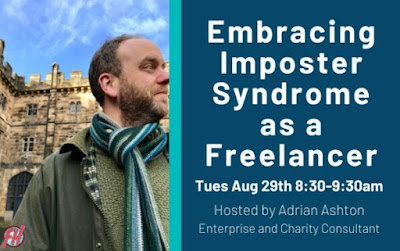
It was therefore exciting and encouraging to have been asked by Freelance Heroes (who are ultimately responsible for my writing the book in the first place), to lead a session to share and explore some of the ideas in my book - in hopes of helping offer fellow freelancers some encouragement and practical ideas for how they might get more out of working as such.


And whilst it's always exciting to share the books' ideas with new people to get their views on my arguments, and what these are based on, I also find it valuable to 'gather some more stories' about people's experience of feeling like an imposter - not just for the sake of possible 2nd edition, but more importantly to share with others through this blog, in hopes that they may be of encouragement to others I'll never meet...


People in the session shared that they'd signed up to it, in recognition of some of the impacts that feelings of self-doubt were having on their freelance careers, and which they wanted to try and do something about:
  • not charging as much as they could/should/(needed to), and so financially struggling more than they recognised that they perhaps needed to;
  • not pursuing contracts or projects that would help raise their profile and secure future work, for fear that they did not hold the right qualifications for it (despite simultaneously acknowledging that they had significant relevant experience).

There was also a key point that one person made about the confusion and overlap between feeling like an imposter, and having a lack of confidence.

It was also interesting and challenging to hear of some of the practices that some of the freelancers in the session had created and adopted, in how they currently deal with feelings of imposterism:
  • phoning a trusted friend for a 'sanity check';
  • adopting a nihilistic mindset, and disassociating themselves from their work, to try and protect themselves against the potential risk of things not working out as they might hope they would.    

As we wrapped up the hour together, everyone shared that they'd found the time together of encouragement, and all committed to take a range of actions as a direct result of it:
  • increase their knowledge about specific areas of their existing work (libraries are always a good place to start for this!);
  • explore and better understand the 'origin stories' of what their doubt about their skill may be rooted in, so that they can design more effective ways to better manage it;
  • create feedback loops with clients and others;
  • talk about these feelings more openly with others, after realising that everyone feels them, to be able to hear others' experiences, and through these, better understand their own;
  • adopt a practice of self check-in questions with themselves when they think they may be feeling it, to help better manage these feelings of doubt and move through them;
  • experiment with different ideas to see which might work best for them (but as with any experiment, always make sure you wear safety goggles, just like when you were at school!).


What also struck me about the session was the number of people who were part of it - normally, on-line sessions and events I've been part of, or heard about, seem to attract (or need to book on) upwards of 15 people - we were a perfectly formed '6', which seemed to naturally allow for everyone to feel they could easily speak, and have the opportunity to explore and directly apply ideas and prompts to their own personal circumstances and situations.

So if you're thinking of joining a session to explore some of these ideas or feelings in the future, perhaps try and avoid the 'sell-out'/'big ticket' types, and hunt out the smaller groups as you'll likely get more benefit and encouragement from them (but only if you're really serious about wanting to do something about feelings of being an imposter...)


Monday, June 5, 2023

being all things to all people - the realities of being self employed and an unpaid carer

This post was written at the start of carers week 2023 - and is based on conversations amongst freelancers and owners of small businesses at events hosted by Freelance Heroes and Atomicon23.

It is not intended to offer definitive, medical, or legal counsel or guidance - but reflect emergent themes and issues that may be of encouragement and support to others; and possibly also highlight future wider policy development needs. 


My name is Adrian, and I'm an unpaid carer for my adult step-child, as well as being a freelance business consultant.

In my head that makes me sound like I'm at an alcoholics anonymous meeting, but maybe it's not too dissimilar: people often struggle to feel comfortable in knowing how to best behave in the company of an alcoholic, and similarly with someone who's an unpaid carer (unless you're living it day to day, it can be hard to fully appreciate the realities of the identities and roles that you hold and manage as such).

But unlike my counterparts who are in salaried, direct employment, there are no legal recognitions for me as an unpaid carer in my (paid) work; and no data on how many other people like me there are - in preparing to host the roundtable discussions that this blog is based on, the Office of National Statistics, the Labour Force Survey, and ipse all revealed that there is no data about how many people who are self-employed/business owners are also unpaid carers. 

A rough-cut extrapolation of data I could find about unpaid carers in general, and different models of employment, might seem to suggest that roughly 10% of the self-employed are also unpaid carers (that's about half a million people!), and of those, less than 1 in 10 have access to any support for themselves in these roles - and as freelancers, we're more likely to be in poverty if we're an unpaid carer than if we were salaried.

Starting to initially explore these issues with groups of fellow freelancers, small business owners, and sole traders who are also unpaid carers like me, saw the following emerge and being shared:


Busting accepted wisdom about origin stories

It can be easy to assume that people who are unpaid carers chose to become self-employed to offer themselves more flexibility around their unpaid caring role - but what came out of the discussions, is that this wasn't always the case.

Often, people took on the mantle of an unpaid carer role after having been self-employed for many years, and as a result subsequently found they needed support with redeveloping how they worked in order to be able to maintain their earnings to continue to support themselves and their families (but this isn't offered/available to them).


Seeing it coming

In one of the roundtables, a person shared how they had joined the conversation to learn from others' experiences because they had recently recognised that in future years, they will need to be more actively involved in supporting the care of their parents. 

They were trying to be pro-active in managing the impact that becoming an unpaid carer would have on themselves, their family, and their business by better understanding the likely realities they will experience when they do. As a result, they hoped to be able to best plan to mitigate the impacts of this - and this roundtable had offered them the first opportunity to be able to do this in any meaningful way.


The need for a better handbook

Through sharing their experiences, people agreed that there was much about being an unpaid carer that they wish they had know sooner, but which no-one had told them (for example - the benefits of being able to be formally recognised and registered as a carer for a family member). 

While there is knowledge out there, it can be hard to navigate and identify ("you don't know what you need to know, so don't know what questions to ask").  People are frequently relying on friends and family for informal (emotional) support for themselves, but as encouraging as these people might be, they rarely know of practical and pre-existing systems and processes that unpaid carers can apply to, but often aren't told about.


The limiting of business growth and potential

A common recurring practicality about being an unpaid carer that was shared, was how it meant that the businesses we had created all had to be limited in terms of their potential to grow in order to honour our caring responsibilities - and with that, our ability to innovate and develop new services and offers in the marketplace.

Whilst this is obviously a personal decision that all unpaid carers find ways to eventually reconcile, this speaks to the impact of the need for unpaid care to our wider economy.


The cost to our personal futures

As well as the financial impact that being an unpaid carer creates through loss of earnings (which is not mitigated through carers allowance were it is able to be awarded), there was also concern about how little support there is for us to be able to access for ourselves in this role - one person shared how becoming an unpaid carer had led to them being diagnosed with mental ill health, and being subsequently needing to be prescribed anti-depressants.

The emotional stresses that unpaid care places on us therefore also affects the future we might have otherwise experienced for ourselves, through it is affecting our well-being today. 


The need for supportive clients

A tension was briefly explored around our relationships with our clients as small business owners - specifically, how far we're open with them about our identify and priorities as an unpaid carer, and how this tension can be managed in how we work with them. As freelancers, our clients come to us to solve problems quickly, responsively, and without adding to their own existing complexity, so revealing we may need to drop them at no notice because of a caring need, may understandably 'spook' them a little...

People shared how their clients were generally sympathetic and flexible in work agreed - but not every business that commissions us will be able to be such; which loops us back to the limiting on our business' potential that being an unpaid carer can entail.


Taking back control

Being self-employed often means we face a barrage of external stressors because of the ever-changing circumstances we all experience that are instigated by others (clients, government, etc) - and being an unpaid carer only exacerbates these through the additional unknowns of how the child, parent, or sibling we care for may respond on any given day to any given event, how reviews of their care or support plans may trigger new complications, and so on.

The roundtables therefore also tried to look at how we're approaching supporting ourselves, and in doing so, gain a little more control over our own lives:

- counselling support from the FSB was mentioned as one of their member benefits, that one person had made use of;

- one person shared how they had chosen to deliberately limit the earnings of their business to reduce the stress on having to work with multiple clients on different deadlines which would otherwise be constantly competing with the needs of their child, that they are the unpaid carer for;

- taking out a private health care plan to be able to arrange GP appointments, any procedures, etc at times that suited them, rather than playing the lottery of NHS scheduling and waiting lists, was shared by someone else;

- registering as a limited company, rather than remaining a sole trader, was shared as a way one person had approached reducing the stress they were feeling about the risks in their business alongside being an unpaid carer.


But these roundtables weren't all 'doom and gloom' as might start to be otherwise interpreted based on the above:

- there was also news about 'Cornerstone', a new emergent peer community for freelancers who are also unpaid carers being created;  

- gratitude was expressed for people having the opportunity to (briefly) share time with their peers, and be edified from hearing that what they were experiencing wasn't unique to them; 

- and people also valued how being an unpaid carer creates space for us to reflect on our own personal identities as human beings.


If you're an unpaid carer you may find the below sites of help (as well as links in the various parts of the blog above):

https://www.citizensadvice.org.uk/family/looking-after-people/carers-help-and-support/

https://www.gov.uk/browse/benefits/help-for-carers

https://www.carersuk.org/help-and-advice/

I'm also happy to offer to speak with any fellow small business owners, sole traders, and freelancers to swap stories that may be of mutual benefit - as well as with any sector or national bodies to further explore potential policy and initiatives that may address some of the themes and issues these roundtables identified:

- the impact to the economy of 500,000 businesses not being able to achieve their potential;

- the need for business disruption to be avoided when small business owners transition into unpaid care roles;

- how freelancers can be better supported to access support/avoid poverty when becoming unpaid carers.


UPDATE 3rd AUG 2023:

Published after these round tables, and blog was written up, JRF have undertaken some further research into this, and found that as unpaid carers who are also freelance/self-employed/small business owners, we pay a #CaringPenalty (suffer lost earnings) of nearly £10,000 every year!
- any wonder so many of us are finding ourselves being pushed into poverty?

Monday, October 10, 2022

could legal company forms help protect my mental wellbeing?

The date of my publishing this post on my blog (Oct 10th) marks World Mental Health day - a time when there are floods of other posts, tweets, emails, etc being circulated, so I don't expect that this will catch too many people's attention, but I've always stated that this blog is in part my 'thinking aloud space' - and this post relates to me 'thinking aloud' about an aspect of my mental wellbeing, and how I try and best manage it.


Firstly - as background to to the title of this post, I've always said that I prefer being a sole trader instead of incorporating myself as a limited company (as conventional wisdom would suggest I should)

This isn't just because I try and be unconventional, but also in remaining a sole trader, I have to pay more tax on my income and earnings that a company director or salaried employee would (and I think that paying tax is actually a good idea). It also means that technically, I've unlimited personal liability - I can't easily "wash my hands" of a problematic contract by simply dissolving a company (in whose name the contract etc, would be, meaning that nothing of the fall out would legally stick to me). As such, it forces me to try and take greater care in how I approach my work and also hopefully sends a message to those I work with that in seeking to establish trust and rapport with them, I'm willing to make myself very vulnerable personally. This element of personal risk is something I also try and further manage through my professional insurance policies, and how I seek to structure and maintain relationships with each person and organisation I find myself working with.


But it's world mental health day, so I'm taking this opportunity to revisit the above position about my not being incorporated to review it from a new perspective - my mental wellbeing.


As a sole trader, parent, carer, etc etc (we all have multiple identities - some of which are more secret than others...), I'm very conscious of trying to best manage my own health and wellbeing, including my mental health. And this list of roles I hold each brings its own tensions, stresses, anxieties, etc that aren't always easy to 'turn off' - but I've always sought to harness what some might see as negative or harmful emotional states that arise from them, to generate responses that help motivate and keep me moving forwards.  

Now, from time to time, I try and take stock of how I'm doing in managing the above - always with a view to trying to see if there might be ways to change a practice or habit that could help  further mitigate or reduce a recognised stressor in/on myself.

And it's the idea of company forms that I'm currently trying to consider to this end - a limited company exists as a 'person' separate to me. It's therefore that person, not me, who would sign contracts, agree terms and conditions, etc - so in the event of the worst coming to pass in my delivering a piece of work (the client decides to sue me), then I could give notice of dissolving the company, and not be concerned about the spectre of potential personal bankruptcy.

However... that's something of a 'nuclear option': I'd only be able to use this fall back position once, because if so 'activated' in that worst case scenario, then all my other business activities linked and associated to and through the company would also cease to be.  And if I then recontacted everyone in my current/original guise of being a sole trader, it would look like I was trying to duck responsibilities, be unethical, and generally exhibit the sort of behaviours that as a society, we decry when we see some larger corporates doing...

And then there's the question of how I'd mitigate the risk that having such a legally distanced structured from the people I'm working with might mean in terms of my becoming complacent in my relationships with them - one of the main reasons I'm currently maintaining my status as a sole trader.


So, on balance, I'm not sure that having identified this option I can actually adopt it - in theory it would offer me an assurance against the 'worst case scenario', and so help reduce a stressor and anxiety. But in practice if I ever needed to enact it, it would mean that I'd have to shut all my work down and not be able to easily restart working in the way I am now - in much the same way that if I were sued as a sole trader (and my insurance providers felt I'd not acted with sufficient degree of professional conduct with the upset client in order to cover the claim), I'd not be able to easily restart working in the way I am now. 

'Killing' a company that I owned could also impact on my personal credit rating (in the same way that getting personally sued might also) - so that consideration also balances itself out.


But it's an interesting perspective on the question that every sole trader and freelancer faces at some point - of whether to incorporate themselves as a limited company; but from a very different starting point. A perspective that seems timely with it being world mental health day.


However, as will all of my 'thinking aloud' posts that I make here in this blog, I'd be interested and keen to hear what holes people might be able to pick in my above 'workings out', and if there's anything that I've missed in thinking this through?  

Thursday, February 24, 2022

how offering pro bono can help us reduce our risk of burnout

With 51% of small businesses owners experiencing burnout since the pandemic started, what should we be doing that we currently aren't to help us better look after ourselves?

In conversations like these around self-managing our personal well-being, there’s often a tacit assumption that balancing looking after ourselves means we have to somehow separate ourselves from the ‘good work’ that we strive to do (or at least, strive to get paid for!), and, in the words of Monty Python, do something completely different.


But what if doing more of what we currently do in the ‘day job’ might actually help us better look after ourselves?


I’ve been reflecting recently with other people about how I approach and ‘balance’ my pro bono work as a sole trader with the need to make sure I keep earning enough cash to keep the rent paid.


Because if we don’t get this trade off between ‘work and love’ working properly, we either find ourselves homeless (evicted after non-rent payments because we didn’t do enough  paid work in favour of our pro bono offers), overwhelmed by guilt at not doing more when we feel we should/could (not feeling able to turn people away who we know we could have helped, but couldn’t otherwise pay us), or trying to satisfy all these demands on ourselves and then seeing the ‘lights go out’.


And the way I try and get it right is through the following approaches:

  • Offering pro bono through structured volunteering programmes: that way there’s someone half keeping an eye on how much I’m doing, and trying to make sure I don’t get overloaded with requests. It also means that there’s also someone I can semi-regularly check-in with to make sure I’m also feeling ok with it all.

  • Tracking the time I spend on pro bono and monetising this: I can then compare this figure to my overall paid earnings. It’s a tidy check-sum as I’ve a target percentage in my mind as to how much I should be ‘gifting’ through my pro bono work.

  • Reflecting with others on how they’re thinking about it and their approaches (all my fellow Club members whom I’ve already been having conversations with about this - it wasn’t all one-way!)

  • And ultimately, trying to accept the truth that however superhuman we might otherwise see or wish ourselves to be, we can’t save everyone.


But I’ve also been exploring my motivations, and the benefits I get from such apparent altruistic service to others.


Whilst there’s a host of other benefits that I could wax lyrical about, something I learnt very early on while offering pro bono is that removing the payment part of the relationship with a group (or person) radically changes how I perceive the dynamic - rather than constantly reminding myself that I need to keep this project moving along in order to be able to get paid (the starting point of the client relationship), I’m instead finding that I’m coming to the project as an equal to the people involved, and much more open to learning with them as we progress. It’s easier to work at a more relaxed, natural pace, and there’s more enjoyment to be had in the time I’m spending with these people and their communities, because I’m not worried about having to ‘watch a clock’ for billing hours.


We don’t often think that the pro bono we offer is a way through which we can take better care of ourselves. I’ve found it a good tonic for refreshing my passion for what I do, having been able to immerse and indulge myself in doing it purely for the love of it, rather than as a means to an end (in this case, making sure the rent gets paid next month).


Wednesday, January 26, 2022

to best look after ourselves, we should stop listening to other people's advice on how to it

After my recent "is it just me..?" rant on YouTube about how it costs us self-employed freelance types more to access the same health and well-being supports than our employed counterparts, I started to think a bit more widely on how we might rethink looking after ourselves.


Putting your needs as priority is not just a nice to have but a necessity if you want to continue doing the good work you set out to do.“ - that’s a statement we’ll all have heard at some point, and found ourselves agreeing with, but likely then struggling to figure out how we actually best manage that.


And whilst for some, we’ll be doing that ‘good work’ as part of a salaried role, for others it’s a core defining feature that informs how we approach everything in our work and lives. And that starts to make it hard when looking at other people’s examples of how they’ve created their ‘perfect balance’* to inform our own approach. (What also makes it harder is that if we’re part of the 4.5 million self-employed, the tax system means it costs us more to invest in our own well-being than our salaried counterparts have to pay for the same activity…)


But I don’t think we should be focussing on creating the perfect ratio of client work, meditating, eating kale, walking the dog, and/or taking holidays in vineyards to ensure we’re best looking after ourselves. The world we live in, and our own personal and family circumstances are constantly changing, so perhaps the ways in which we seek those recharging times/moments should also? 

  • Why not start to allow ourselves to be properly invigorated by the outcomes of the ‘good work’ we’re doing? Share in the stories with clients as to the positive outcomes we’ve helped create for people, communities, and the planet in the weeks after we’ve completed our assignments with them (also a good way to potentially generate some new introductions and prospects for repeat business if nothing else!)
  • Instead of fixing hard times each day/week for specific activities, try and use spontaneity and serendipity to show yourself some love: as Agent Cooper of the FBI once said, “every day, once a day, give yourself a present (but don’t plan it)”**
  • And as much as it’s cliched, find ways to share your stories, frustrations, and hopes with other people who really get what it’s like to run the type of venture you do. We can’t wave a magic wand for you (although, I have do have a magic wand that I use from time to time), but the act of vocalising the stuff in our heads, hearts, and guts, has a way of either giving it the power it needs, or reducing the power it has over us.


Ultimately, this is a theme that loads of other people have/are/will write about, and the subject of countless books, podcasts, and TED talks. All of which will be useful for someone (usually the person who created them), but those people aren’t you - and only you will know what works best for you in helping you not ‘see the lights go out’. What works for you will be right for you - try out different things, be kind to yourself if none of them seem to work to begin with; keep trying until you find those things that were always meant for you.


Perhaps the hardest part in all of this though, is that YOU have to make the decision to invest in looking after yourself. And that’s probably the hardest part of figuring out how to look after yourself when we see the need around us that others are constantly struggling with. It took me over 20 years to be OK with allowing myself to be ‘selfish’ from time to time. Hopefully it won’t ever be that long for anyone else.


*the ‘perfect balance’ only ever exists in Instagram posts


** If you don’t recognise this quote or the Agent’s name, then go and binge watch Twin Peaks as soon as you can