Showing posts with label history. Show all posts

Tuesday, July 29, 2025

Who do you share your anniversary with?

As I've been (trying to) reminisce about what I've been doing in and with my business over these last 20 years, I started to wonder who, and what else, I'm sharing this porcelain anniversary with.

The below list is far from exhaustive, but highlights a few others who started on their respective journeys and adventures at the same time as my businesses did - and which I take to show that I'm in good company!


YouTube - It feels like it's been with us forever, but it really is only 20 years old.

Dr Who (the RTD reboot) - it was 20 years ago that our lives were reacquainted with the wheezing and groaning of the TARDIS as it returned to out TV screens after what felt like a lifetime of being in limbo in the time vortex. And running. An awful lot running also returned with it.    

The global Impact Hub network was formed - a movement to harness, encourage, and amplify entrepreneurs working to create, well, impact (for good). I've been fortunate to have opportunities to work with some of them in overlapping our common goals in this regard. 

The Freedom of Information Act was introduced - I've always tried to be transparent and open in my business model and practices, so it's encouraging to see that other things were starting to change in the wider world to encourage others to do similar at the same time.

Enterprise Nation was formed - they've subsequently shortlisted me as the UK's top business advisor 3 times, invited me to lead 2 of what have become amongst their most popular Lunch and Learn sessions, and profiled me as one of the featured advisers. Which is nice.

English whiskey was re-established in England - 'nuff said.

UK's The Apprentice aired for first time on the BBC - and I'm still waiting for the call from Lord Sugar... 

The (American) Office premiered - and none of us ever looked at a ream of paper (or desk) in the same way again.


But who and what does your respective enterprise, charity, co-operative, or other, share its anniversary with?

Friday, January 3, 2025

after 20 years, it's time to go to the toilet

My business is 20 years old.

20 years! Only about 10% of enterprises that start-up get this far. 

To put this in perspective - when I started out, smartphones didn't exist! (it would be another year before the first tweet was posted; 2 years before the first iPhone was released on the world; and 3 years before Dropbox was launched. The typical best internet speed was 1Mb compared to around 900Mb today - we had to rely on using sharpened bones to scratch messages onto stones, and then hope people picked those stones up when we threw them at them).


Now, it turns out that the material associated with this particular anniversary is porcelain - something that most of us here in Britain associated with toilets.


But for me to have gotten this far, porcelain actually seems an apt simile for me:


  • it has a high elasticity - to be able to keep up with all the changes in the world over the last 2 decades, the range of work I do, and types of organisations I support across all sectors, means I've had to be able to easily keep stretching myself.
  • it has considerable strength and hardness - I've pushed hard on some things over the years, often to personal and professional criticism and opposition. This includes: (successfully) challenging CIC legislation; publishing a book that exposes most of the claims that people make about 'imposter syndrome' to be unproven and/or not based in any factual evidences; shining a brighter light on the 500,000+ unpaid carers who are discriminated against by all the bodies that are supposed to be supporting them because they're the only type of carer who aren't recognised in law for the sole reason that we're also self-employed; and calling out the apparent unprofessional practices of some social investors, which are damaging the wider sector; to name but a few.  
  • it's translucent - I've openly published details of how I'm creating (or not) impacts of different types each year; and also been honest in my blog posts about when and where I've gotten things wrong.  
  • and it has a high resistance to shock - if you've followed my blog over the years, you'll know that since becoming self-employed, my family has been made homeless twice; my father (who lives at the other end of the country) has almost died twice; I've navigated a difficult divorce; been investigated for tax fraud by HMRC three times (and cleared every time); had 'unannounced police visits' late at night; and so on. So much so, that the few people who know just how much 'shock' I've had to respond to and work through over these last 2 decades, are all amazed that I'm not only still in business, but not needed to be admitted anywhere...

So I'm actually pretty chuffed to be associated with porcelain.


But I also didn't want to miss the opportunity to try and mark this milestone - so, linking back to the toilet analogy, I've decided to twin my office toilet with a school in Uganda via 
https://toilettwinning.org/


25% of all human beings today don't have somewhere safe, clean, and hygienic to go to the toilet. Not only does this create all sorts of associated 'bio-hazards', it strips fellow people of their dignity. And if schools don't have toilets, then kids will find ways not to go there for those reasons, and as a result, lose the chance for education and so lose the future that they could/should have had, including the opportunity to break generational poverty.


So the next time you're paying a visit to the loo this year, please think of me and what you might be able to do to similarly 'be more porcelain'; and maybe if you might also be able find a similar excuse to twin your toilet with someone else's. 

Wednesday, April 13, 2022

social enterprise legal structures for humans

Some people regard me as an expert authority on legal and governance forms for social enterprise, community businesses, and co-operatives - and while I always encourage people not to trust any guidance I offer them on this topic (because I'm not academically accredited in legal stuff, and more importantly because I'm not the one who's going to be legally responsible for administering the chosen form), people take encouragement from my achievements in changing company law, navigating Society Rules with the FCA, and finding paths through charity legislation.

Over the decades that I've been supporting people understand these choices, I've created a few tools/prompts to help focus discussions and reflections ('CHAMP' and 'Adrian's 4-boxes') - but this post isn't about those tools - instead it's about a 3-part limited youtube series I was invited to be part of the 'main cast' for.


A contact through one of my networks had approached me to ask if I could help them explore and understand what the best legal form for a new social enterprise they were developing might be. And as we talked about how I might offer guidance and assistance, we hit on the idea of making this a 'performance piece' - drawing back the curtain on how people usually go through this process as an encouragement to the wider sector, and also a working out of some of their (and the emerging enterprises') values.
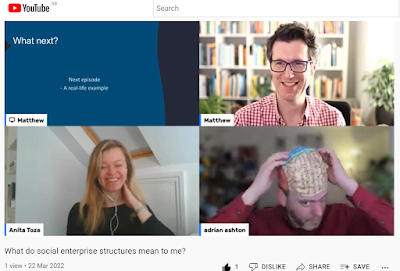
So we scheduled 3 afternoons to talk though approaches to not only understanding why this legal form question is so important to get right, but the different ways we can pick and choose between them, and finally, applying all of this learning in real time/live to their nascent social enterprise.

There's an 'official' long post on LinkedIn by Matthew Bellringer (the contact that sparked this) where you can get the official story of how this series came to be: https://www.linkedin.com/pulse/foundations-thriving-social-enterprise-matthew-bellringer/ but I wanted to take the opportunity to reflect on how I found this process, in it being different to the ways in which I usually offer this type of support - to pull out what surprised me that I hadn't considered before, what was an encouragement in allowing more time and space to explore than is usually available, and some of the things which you don't normally hear or read about in this area.


So - the below points are what I think are useful framing/warm-up for anyone thinking of approaching either choosing or reviewing a legal or structural form for their social enterprise - if you want to know more about them, you'll have to follow the links to youtube and watch all 3 episodes...

- Comparing legal structures to buying second-hand car: you wouldn't buy a car without wanting to know some of its history to assure you that it's been built well, and looked after, so why don't we seek the same assurances when deciding between legal forms?

- The risks of using data that maps legal forms used by social enterprise in helping us choose one for our own: as part of the episodes, we looked at research into how far different legal forms are popular/less popular by the wider social enterprise sector. But as you'll see as you watch this segment, this mapping - as undertaken by national sector bodies, often presents a contradictory picture of findings. As with all research, what you find depends on how you ask the question, and whom you ask it of. And it seems that our sector leaders can sometimes do this in ways that might not seem to be that robust..?  

- None of the existing tools designed to help you plan your social enterprise model (social enterprise canvases, specialist business plan templates, etc) help you relate your ethos and values to the legal form you'll pick. Which seems a bit bonkers, because your chosen legal form is probably one of the best ways you have to make sure said ethos and values can be best protected into the future. That's why I developed my 'CHAMP' framework, which is profiled in detail through these episodes.

- Your legal structure as a social enterprise can influence your credibility to lobby and speak out on social issues. For example, charities and CICs are banned from undertaking political activities: but if we're serious about creating systemic change as a social enterprise, then at some point we have to engage with the policy and law makers (which perversely, our chosen form may actually prevent us from being able to do!).

- The problem with all of the toolkits designed to help making the process of picking a legal form easier is that they assume you understand the jargon, and underlying concepts associated with legal forms and governance. Which most of us don't, which explains why these toolkits are so underutilised by the wider sector.

- There's a confusion about Members, members, and membership, that knots so may people up when approaching social enterprise legal forms: one has legal power over you, one is a supportive friend, and the other is about collective activism that influences your decision making. Can you tell which is which?

- Stickers and badges, or legal power – which would people prefer to have in your social enterprise? And which would you want people to have? (remember that there are wider trends going on in society that means formal membership bodies are generally seeing their numbers start to plateau and decline - people may be more interested in being part of you for specific periods, rather than for life).

- We managed to compress over 400 years of legal structures for social enterprise into just over 10 minutes. A new personal best for me!

- How the regulator for your chosen social enterprise legal form can strengthen others' trust in your venture. None of the toolkits or other materials 'out there' that I come across to help you decide about legal forms ever talk about the regulators: what they can do to you, how they can support and protect you, and how they may influence how others see you. But this is also a far wider issue and problem: I also see it a lot of start-up programmes, where social entrepreneurs are supported and encouraged to start-up and incorporate their ventures, but then given no support in knowing how to 'look after it' with their respective regulator - leading many early stage social enterprises to suffer fines, penalties, and even enforced winding up because no-one explained to them about the regulators... 

- It turns out that knowing how to bake cakes can be very helpful in informing how we approach designing different membership models in social enterprise legal forms.

- Campfire songs can be equally important in the selection of choosing a legal form for a social enterprise.

- and finally - why every social enterprise should be wary of S&M clubs if they’re going to be a CIC.


I've found myself enjoying this process of working with a group to find an answer to a question, and also that it's encouraged us to take more time in how we consider the options and implications - despite doing the whole thing remotely to each other with video calls, etc, it's felt like it's helped to make choosing a legal form a process that's allowed us to be more human. 


Episode 1: what's a social enterprise, and why do I care?  

https://youtu.be/5T7TzanQh0s 

Episode 2: what do social enterprise legal structures mean to me? 

https://youtu.be/EaRRsWPfDK0

Episode 3: social enterprise in the real world. 

https://youtu.be/JmEi3b6f9_g 


Wednesday, November 17, 2021

the great resignation, being pushed, and becoming superheroes

There seems to a growing awareness of a movement that's come to be known as "the great resignation" - Covid and the pandemic have forced people to re-examine of what they were doing almost automatically in their lives, and many are finding that they're unhappy with what's become their lot, and are spurring themselves to change that. Mainly by quitting the jobs that currently leave them unfulfilled to pursue hopes and dreams that will better feed their souls.

And it got me thinking about our origin stories as freelancers and entrepreneurs.

Usually, when people share them, they seem to echo the current 'great resignation' - people "felt the fear, but did it anyway" and heroically quit their jobs to pursue their dream. (and research studies like this one from theRSA re-enforce this)

But, as usual, my origin story isn't in keeping with this typical narrative. (TL:DR = relocated my family to the other end of the country in a pre iphone age to find said job didn't exist, and the first work I could find to allow my family to remain housed and fed meant I was forced to go freelance).

And it's made me wonder about if we should all try and be a little more honest about where we've come from (especially if it's not from what seems to be the usual position of having savings, a partner still salaried, and clients already confirmed, before jumping off an otherwise dependable monthly payroll). The point of which would be to better challenge stereotypes and misconception, and encourage others who might otherwise think that they haven't 'got what it takes', and subsequently live a live of regret and missed opportunity for themselves and those around them.

And the actual research out there also seems to encourage this: theRSA's "salvation in a startup" found that there's actually a far wider range of motivations in play for those of  us who find ourselves self-employed than might be otherwise first imagined:


Might it also also make us more like the superheroes we always wanted to be when we were kids (although some might say that if you're part of the Freelance Heroes community, you're half-way there already!) - because we remember and know who the likes of Spiderman and Batman are in large part because we know what their origin stories are...?


Monday, May 10, 2021

laser discs, pagers, and social accounting

History is littered with examples of technologies and systems that were of higher standards and quality, but which were supplanted by inferior products and offers.

And that's the frame I want you to have in mind in this piece on 'social accounting' - a practice that dates back centuries, and in recent years, has seen substantive growth in interest in it through the adoption of Social Accounting, SROI, and such like which businesses and social enterprises have developed amongst themselves.

In large part, this has been driven by government interest in how public services can provide more 'bang for its buck' - starting in 2001 as a policy aspiration, this led to the introduction of legislation to start to mandate how the delivery of government contracts should now include going 'above and beyond' the core deliverables to generate wider benefits to communities and society at large. 

This drive by government is in turn largely responsible for the emergence of 'TOMs' - a relative newcomer to this arena of reporting social impact and value (it wasn't until 2017 that it's first framework was released). And whilst many who've been working in the impact sector for some time aren't fully convinced by it, it's quickly gaining traction as the de facto/go to model for local authorities and other public sector bodies to design and understand how social value will be being created and should be recorded and evidenced in the services they commission and contract.

And that creates a tension in how our services and activities are designed and managed - should the impacts that they can create be constrained to the narrow focus that TOMs has pre-defined (and in doing so, ignoring the wider value we create through how we work); and also only consider our impact through the lens of what it can be financially valued at? (which may make reporting simpler, but misses the point that some things are valuable but can't be reduced to a £). 

But it's not just TOMs - the housing sector created the 'HACT' framework in 2012 to identify and monetise services relating to where and how we live, and the construction industry is also piloting a new national value standard.

Such developments not only add to the confusion over how we should best approach thinking about, and understanding, the ways that our activities and services create benefit in the wider world and for the people and communities whose lives we touch. This is further complicated in that the resources associated with each of these new standards can make it hard to be able to justify adopting more than one of them.

So it seems we have a choice - do we stick with models of social accounting that many feel are of a higher rigour and relevance, and go the way of the laser discs and pagers; or do we accept that the world is shifting around us in ways we can't control, and pragmatically change our thinking and practices so we remain 'in the game' along with everyone else?

It feels like we're approaching another 'betamax vs vhs' showdown, and maybe this is one time that although we feel we're working to higher standards, we have to accept that to remain able to engage with commissioners, funders, and others, we have to shift how we think about how we report our impact to a 'lower standard', in order that we're not 'left out in the cold'... 

Monday, March 22, 2021

Co-ops will never succeed until they start demanding more money from people who want to join them

The co-operative movement is often referred to as having emerged from Rochdale in 1844 (although it's history goes far further back than that) - a time when the average life expectancy was a mere 21 years; and most people died in the streets wearing nothing but rags.


The co-operative society that was formed then did two very powerful things that have since resonated through history: one has defined the movement globally (documenting a set of core values and principles); and the other has come to limit the interest of people in not only becoming members of co-operatives, but subsequently also not being interested in being actively involved in their governance (the setting of a membership fee of £1).

Whilst those values have gone on to be argued about, expanded, refined, and ultimately codified by the International Co-operative Alliance as the acid test of what makes a co-op a co-op, that membership fee has largely remained resolutely steadfast at £1 in nearly all co-ops.


Today, most people in the movement would argue that it should remain £1 - this is the lowest amount the law will recognise and allow, and allows for inclusivity: after all, no matter what your circumstances, you can scrape £1 together relatively quickly and easily.

But adjust for inflation, and that £1 should actually now be £128.


However, inflation only looks at the nominal buying power of that £1 - it doesn't recognise the extremes of poverty and deprivation people whom that co-operative in Rochdale was created for, and how those might transpose to our society of 2021.


A couple of quick google searches identifies that in 1844, people were most likely to be factory workers or labourers, with an annual earning of around £20.

Compare that to the average UK salary in 2021 which is £29,600 (as at 18th March).

And suddenly we start to some some big differences.


If I were to join a co-op in 1844, it would cost me 5% of what I could hope to earn in a year = roughly 3 weeks earnings (nearly a months wages) .

3 weeks wages today would be equal to £1,700.


Suddenly it becomes apparent just how radical the co-op of Rochdale was, in what it represented that meant people were willing to give up so much of what they would have otherwise spent on their rent, meals, and health (no NHS in those days!).

If you invested nearly £2,000 or a month's wages in something, you'd want to make sure you were getting value for money and a return on what you've otherwise have been spending it on (insert your favourite vice here). You'd want to make sure your voice was heard: you'd engage with any and all opportunities the organisation offered you to be part of its governance and decision making.

In short - you'd be actively involved, because it had hurt you financially to be part of it.


Most co-ops today struggle to not only recruit members, but also to encourage and maintain their involvement and engagement in their co-op's governance and activities.

Could it be because the movement hasn't paid enough heed to its history, and forgotten just how much it asked of people who wanted to be part of it, in order to keep this cost of membership current and relevant?


If co-ops today suddenly made the cost of membership £1,700 (after all, they all echo nearly everything else that the Rochdale co-op mandated and advocated), I suspect we'd seen an initial drop in member numbers. But those that did become members - how active and dynamic would they be in the democracy of their co-ops?  

Thursday, November 21, 2019

reporting social impact - 150 years in, and 8,000 to go...

If you're getting involved with starting to report social value/impact, and find yourself confused about all the different models, standards, bodies, and approaches, then don't panic - you're right where you should expect to be!

Preparing 'social accounts' is often likened to the preparation of a set of financial accounts - tracking what resources have been used, and what's changed (good or bad) at the end of a period.


However - as a species, we've been collectively agreeing how to 'do' financial accounts for about 8 millennia (the earliest reference I can find dates back to about 8,000BC in ancient Sumeria...). But we've only really been doing 'social' accounts for about 150 (the earliest references I'm aware of are co-operative societies in the mid nineteen century sharing how they were impacting on their members and communities).

So if we've been working on agreeing consistent standards and approaches for financial accounts for this long, why is there the sense of urgency and panic to nail the way in which we report the social value and impact alongside the financial stuff?

And just to add to the complication, financial accounting had only a few key audiences who were interested that it was gotten 'right' (investors, regulators, government), whereas social value and impact has far wider groups that it needs to satisfy (providers, commissioners, communities, employees, beneficiaries, customers, grant making bodies, policy makers, and so on and so on...)

So isn't it about time we stopped panicking that we've not yet reached a global consensus on the measures we should all be using when we talk about our value and impact..?


Monday, January 7, 2019

are community businesses starting to fail, or are we simply becoming more honest about the true nature of them..?

A few years ago, there was a jamboree around 'community businesses' - enterprises that are led by the community they're based in; operate and trade to meet the (social and health) needs of those local areas; and generally make that area a better place for everyone to live and work in it.
This was precipitated by the formation of Power to Change - a charitable trust whose remit is to nurture, encourage, and support the growth and impact of this sector of businesses.

Over the last 5 years since it's creation, Power to Change has initiated a range of programmes and support, which have, in turn (and to me at least), seemed to also catalyse a range of other good things starting to happen through other support bodies to the sector.

However, one of the things about Power to Change that's impressed me most, is its commitment to research, data, and openly sharing it's findings. I've drawn on some of these published findings in previous blog posts, in exploring what they can add to other researches and data from other bodies in seeking to better understand specific themes, but this time thought I'd look at their own data on the community businesses they exist to support, from a longitudinal perspective.
I've always thought that having more than a "this year vs. last year findings" is important in any context as it means you can better start to identify trends, blips, and other happenstance events (last time I did this it was on complaints received by the CIC Regulators against individual Community Interest Companies, the findings of which still cause shock amongst people I share it with...)

And when I look at the 4 years worth of 'State of the Community Business Market' reports that have been collated and published to date, I can't help but wonder if we shouldn't be making more noise about the general state of community businesses, and in particular, how the sector appears to be worsening...

As some who've read previous blogs of mine may recall, I don't claim that analyses like these are based on sophisticated or technical regression techniques and other sensitivity analyses in data sets, but merely what a regular lay-person might find if they were to apply some basic maths to the headline figures reported.

In this instance, I took the figures from the last 4 years of reports, and worked out the average (mean) figures of what a typical community business looks like from the headline figures in each - the charts highlight the story, but in summary:

1) there seems to be a general overall increase in the numbers of community businesses (up 2,000 over the last 4 years), but...
2) the average income of community businesses has fallen by nearly £20,000 (roughly 10%) over the same period;
3) the average value of assets they hold each has fallen by over £150,000 (roughly 60%);
4) they're employing 20% less people, and, before anyone points out that that's because they're making greater use of volunteers - the number of volunteers has also fallen too (by around 50%)...
5) they're also becoming more reliant upon grants over trading to help sustain themselves, and continue their activities into the future


Now, it may be that this is all easily explainable: in the reports themselves, Power to Change are very clear and open that each year the methodologies used to research and generate the data are changing - so there's a strong argument to debunk the above on the basis that I'm not comparing like-for-like. Except... for the figure about the overall number of community businesses which seems to be on an upward trend - if anything, this would suggest that the methodologies are actually getting more effective and precise in identifying and profiling community businesses. 
And if this is the case, then that surely means that a combination of things may be going on:

1) the strength and scope of community businesses, upon which national policy and investment programmes have been based, have been over-estimated, which means that the support now available isn't actually what's most needed...

2) Power to Change has been 'too successful' in inspiring a faster than historic growth in the sector of new community business start-ups, whose financial and operational standings will be far more immature (weaker) than their more established counterparts, and this is skewing the overall averages - although the age of community businesses isn't something that's closely monitored in these reports, parallel mapping by Social Enterprise UK highlights that most of the wider social enterprise sector (of which community businesses form a part), are disproportionately 'young' in comparison with private businesses).


So - all in all, a false alarm for community businesses after all?

Maybe, but as I pointed out earlier, I've done this rough analysis on the basis of how someone taking the headline figures from these annual reports might look at them (and perhaps be unwitting misled?)
And given that other national support initiatives, investment, support, and funding programmes usually take a year or two to 'roll out', in light of them being potentially based on flawed assumptions and data, will this mean that they 'miss their mark', unless they regularly pause to reflect on findings such as these about the wider sector that they're working in, and respond accordingly..?

Tuesday, October 23, 2018

member only content

there seems to be an increasing trend on the internet towards content being hosted behind paywalls - the number of emails I now receive with links to research, features, and articles which are increasingly marked as 'member only content' when I try to read them, is starting to annoy me...

I fully appreciate that in an increasingly fragmented economy, people need to find novel and clever ways of being able to earn a living (or something approximating one), and so the potential to earn 'micro payments' of a few pence from people clicking to read your blog post or news feature may seem innocuous enough. But I'm concerned it may herald the dawn of a new net age of digital inequality - not from access to the technology which is the current digital divide, but from not being able to access information or learning when you do.

When the internet was created, it was intended to be as freely open and available to as many people as possible. A principle that chimes with the declaration of human rights, whose Article 26 states that everyone has the right to education [to be able to access learning], and that this should be free; and Article 27 which says that we should all be able to freely participate in the cultural life of our [on-line] community. 

Image result for medium member only content
If we start putting up charges to access content, then we start to limit the sharing our learning and experiences with each other - we start to segregate our communities into those who can afford to 'play with us' and those who can't. Which means that potentially increasingly large numbers of people will lose access to articles and research that could help to further understanding, constructively challenge prejudice and bias, and generally create a more consistent experience for us all on-line and in our lives.

I also appreciate the argument that we only truly value things we've paid for, but if the established norm in the marketplace of internet blogs and articles was that they were freely shared, then surely we need to be having a wider and deeper conversation about the effects that our use of 'member only content' may be creating in exacerbating inequality, stopping prejudice and bias from being able to be challenged as they could/should be, and generally increasingly p!ssing people off who are trying to contribute to the overall pool of knowledge and learning at the cost of our own time, in keeping with the original spirit of the internet, only to see others seemingly starting to exploit it for selfish gains...?

Monday, September 18, 2017

"ain't nothing like a Dame", forgotten legacies, and growing lettuces in space... (the future of the co-op movement from a regional perspective)


I was recently invited back to my old stomping ground of Cambridge to speak at the Regional Co-op Council's annual conference - as some may know, I spent several years turning around the fortunes a local co-op and social enterprise development agency there, and somehow initiating some ideas that have since become national flagships...


And the invitation was too tempting to pass on: in 1997, The East of England was the first in the country to form a regional co-op forum (which became the regional Co-ops Council model today), and in doing so inspired every other region in the UK to not only form a corresponding Council model, but also informed every region to then go on to create a wider regional social enterprise partnership too! (and I was involved in the forming of both this first regional council, and the subsequent first regional social enterprise partnership too, so nice to go back and see how it was getting on)
The East of England was also the first to create a 10 year strategy for shaping the future of the co-operative movement from a regional perspective (which I still have a copy of!, although sadly just about everyone at the Coops East conference seemed to be unaware of just how influential they've been in shaping the wider movement and beyond through these things in its history...).
Therefore being able to return to remind them of their history and legacy seemed an important thing to do in encouraging the next wave of the 'co-operative revolution'.
(and it was also personally encouraging for me to be able to see some people I originally got to know 15 years ago still active and impacting the world through their roles - Austen and Sally: yes, that's you I'm referring to!)

While the day itself may have seemed to have had too many speakers for some people's comfort (8 main presentations, 2 facilitated round table planning activities, and a break for lunch - and all in the space of about 5 hours), my impression is that many also felt that they wanted more... and my overriding impression was that rather than blinding people with stats and policy headlines, all of the speakers more appropriately drew on stories and histories of their respective co-ops - its stories that capture our interest and imagination much more powerfully, and make it easier to share these ideas with other people, than any set of quantitative data and mapping reports ever can.

So to try and summarise what impressed upon me most from the day means I'll omit some things that others felt were the highlights for them, or focus on some aspects that others felt were more of an irrelevance. But that's part of the joy of blogging - encouraging you to subsequently read others' write ups and form your own view, and a reflection of the diversity of the co-operative movement itself. However, for me the 'highlights' I'd like to share are as follows:

  1. Co-ops were highlighted at being at the forefront of the next agricultural revolution with the workers co-op, Delta T Devices, sharing how their equipment is helping to grow lettuces on the international space station
  2. Dame Pauline Green passionately argued how co-ops have become the UK's greatest ever export, revealed how she's now a good mate of the Pope, and had people highlight that a musical about her work for the movement is already well know - "There is nothing like a Dame" from South Pacific
  3. Tweets that people were making on the day drew interest in what Coops East were doing from the co-operative movement internationally
  4. It's impossible for nearly any co-operative to fully cover all of the impact and ways in which they are contributing to making the world a better place in only 9 minutes
  5. While some co-ops may be accused of having too many aims for their own good, and people encourage them to therefore reduce them in number; if you were a parent with 'too many children', how could you choose which of them to give up?
  6. People's ideas for what a 'paradise region' might look like if the East of England were to be transformed by the co-op sector struck me as being reminiscent of the role that Co-op societies held in their communities at the start of the 20th century (community social events, everyone being aware about what co-ops are and using them as their preferred suppliers and shops, schools being explicitly linked with coops and teaching children about them, local businesses being encouraged and supported by them...)
  7. Some co-ops present (and who spoke) seemed unaware of the national programmes and influence they'd created over the years until I referred to some of these during the Q&A panels
  8. I also found myself being volunteered to chair the conference in lieu of my father who was too unwell to do so, and so naturally took the opportunity to do some table-top dancing as part of the official proceedings...


I think my overriding takeaway from the day was that as a movement we have a legacy (and future) that is far more impressive and powerful than most realise, but we risk losing it all if we forget our history and don't keep regularly sharing and reminding ourselves of our stories.

But the whole day was also tweeted and instagrammed about by various other people there - just check out the day's hashtag to see other's pictures and stories via #acoopregion; and Coops East have also uploaded all of the speakers notes and presentations to their website: http://www.cooperatives-east.coop/events/acooperativeregion/

Monday, April 13, 2015

a(nother) new era in social impact/value reporting...

It's that time of year again - the end of most groups' financial reporting period and the start of their thinking about collating all their records into the annual accounts for filing with various bodies. It's also the time of year when I also start to collate my records to produce my 'social accounts' (social impact/value report) on myself (and to my knowledge, am still the only freelance consultant globally to do so...see here for last years': http://bit.ly/1kS2ol2)

This will be the 9th year I've produced and published this perspective on my performance in openly reflecting on how far I've been able to enact my personal values in approaching and delivering the support I offer to various groups. And just as with previous years, I'm keen not to rest on my laurels, but to keep refining the framework and methodology, to make it even more useful and relevant as a document.

This year's evolution was prompted by my role in delivering the financial management module for a programme with Anglia Ruskin University that supports managers of charities and social enterprises better lead their respective ventures. I was reflecting with the current cohort of learners on the stories that accounts tell, and how frustrating it is that accounts only show a very narrow period: the last 2 financial years. It's hard to gauge if what's being reported is the 'norm' or has been subject to 'blips' - especially as the supporting notes to financial accounts are usually very brief and don't tell everything they could.
And that prompted me to think about how I present my own social accounts (and how all other organisations I know who also produce social accounts report theirs): many of the measures I report against I've been using for several years, so can easily start to spot trends and norms within them, but what of the casual reader of them who's not been following them with me for the last 9 years? I've always reported the results of the last year against the previous for comparison, but will now be including a 3rd column - the long-term average of each indicator to make it easier to see if my impact/value is improving or waning...

And what do they show for this year? Well, I've already generated the report, but you'll have to wait until next month when I'll be releasing it as part of the first Social Enterprise Festival in Greenwich where I've been invited to speak on the theme of reporting social impact and value. So you'll either have to book a (free) ticket to the session, or wait with baited breath until afterwards... 
However, as with previous years I'll also be publishing it via twitter using the tag #AAimpact15 as well. Some may recall that last year this led to an 'interesting' twitter debate between myself and Liam Black as to the validity of any accounts (social or financial) that aren't independently audited. Am looking forward to what the twittersphere makes of my latest results...


Thursday, November 20, 2014

Why I like hearing about social enterprises failing

That's a bit of a provocative title for this blog, but then, I've always tried to take an approach of 'poking a stick' at accepted wisdom and cherished institutions to get people fired up enough to start to ask questions they should be, and not meekly 'going with the flow'. If nothing else, I hope that in doing so I can encourage people to think more for themselves and seek out what the right options might be for their enterprises and ideas, rather than simply accepting what they're offered by 'a professional advisor'...
 
But back to the topic in hand - why I like hearing about social enterprises that fail (and there was one that was lost in Scotland recently, to much apparent wailing and gnashing of teeth locally...).
 
Social Enterprises are politically in vogue (and have been for some time - apparently, every year since 2001 has been 'the best time' for them, and the point when 'their time has come'...). And that means with such interest from the state and investing bodies, we need to make sure that we show a successful story and evidences of great things happening. Heaven forbid we should let slip that just like other businesses, we sometimes struggle, stumble, and fall, as that would run counter to the messages that sector bodies and funders are keen to project...
 
And as a result we hear a lot of case studies showing how great it can be, and hear a lot about 'good/best practice' in the sector. But I've never been a fan of 'best practice' as it's usually based on specific people being in a specific place at a specific time. And that's very hard to replicate elsewhere. 'Bad practice' by contrast, tends to be a reflection of more common mistakes and erroneous assumptions - and as a result is much more applicable universally in the learning we can gain from it.
 
Only talking about successes can also create false and unrealistic expectations amongst communities, individuals and investors/funders. And so when they fail to deliver, this wider ecosystem of support and encouragement gets dented and becomes less supportive and interested in working with us.
 
So, lets be more honest about the realities of social enterprise: just like any business, they can sometimes fail. And in being more open and honest about that, we can better learn how to make them stronger in the future, and how better-grounded relationships with others we engage with.
 
Let's celebrate social enterprises and the success stories that exist, but lets also celebrate the learning to be had from when they stumble - it's nothing to be ashamed of, and in the times when we've not succeeded, through the sharing of our stories we may paradoxically better support others in their journeys that if we had succeeded...

Thursday, October 9, 2014

whatever happened to the Conservative Coops?

So, its party season again, and with a general election looming, every sector seems to be vying for attention with all the separate parties to become the solution that they’re each hoping to find that’ll help them to deliver on all their aspirations but won’t bankrupt the economy in the process...
One such sector which every party (at least in recently history) has embraced and talked up are co-ops: marrying social justice with economic independence and free market economies, they seem too good to be true and have often been cited in many a politician’s speech as to their ‘fab-ness’. Recently, co-op sector bodies such as Co-operativesUK have also started to more explicitly publish the ways in which co-ops can help each party deliver on their conference promises too.
But how far can we really hold faith in these political parties’ interest? Historically, government and political parties were so anti-coops that the movement formed its own political party to ensure that the sector wasn’t discriminated against in parliament! In more recent history, the Conservative party launched its own co-ops initiative. “The Conservative Co-operative Movement” (CCM) to capitalise on politicians’ interest in co-ops and to help keep this sector at the heart of parliament and to their policy and thinking. And they even set it up as a co-op society! (Intrigued, I even became a Member of this society, despite my father being a Labour councillor and a Co-op party Chair...)
But fast forward 4 years. In that time as a Member, I’ve had 3 general emails; 1 item of post (with postage underpaid on it); no notifications of Members’ meetings (or minutes from them); and I also spotted that they’ve been identifying themselves by another co-op society’s registration number in their stationary. Their website seems to have disappeared and I’ve not been able to get any response to messages I’ve sent to contact details I have.
What can I conclude from this?
In the absence of any response that may suggest otherwise, it seems like the CCM were an opportunistic political attempt to cash-in on the integrity and hard work of the co-op sector over the last few centuries. It’s obviously not understood what it means to be a co-operative by not acting as one. And it doesn’t seem to notice when it stops being able to deliver what it was set up to do.
Some might say the above analysis and conclusions are reflective of this wider political parties approach in general, but I couldn’t possibly comment...

Monday, September 22, 2014

why not all coops should live to be 100

There are any milestones in the life of any business: the first (and 1,000th?) customer, the opening of new sites, and the length of time that the venture has continued to trade (this is no mean feat given that most fail within the first 3 years...)
 

Many ventures mark their trading histories with parties and such like at 25, 50, and 100 years (although there’s not many of that last group!). And as a supporter of various types of enterprise, it’s always gratifying to see how some business forms seem to survive the ‘test of time’ better than others – I’m not sure the empirical data has been collected to prove it beyond shadow of doubt, but my hunch is that proportionately speaking, co-ops tend to last a lot longer than any other form of business model.
And that’s important, because it shows there’s recognisable value and merit in specific types of business over others that make it easier to argue for them on the groups of sustainability, long-term impact and benefit, etc...
But – that might cause a problem for some co-ops.
Co-ops are created by groups of people to meet common shared aims or addressed shared needs, (rather than the ‘traditional’ motivation of private businesses which is to keep making money for as long as possible...) Once those aims have been achieved, or needs have been met, is there a benefit to it being continued?
Some aims and needs will always be ongoing (creating opportunities for employment, ensuring access to healthcare, or supply of energy), but what of those that can potentially be ‘fixed’ within a given time (supporting each other gain access to financial services through rebuilding credit ratings, or building members’ profiles in their respective marketplaces)?
As well as supporting them to start-up, I’ve also been involved with supporting co-ops wind-up because they were so successful in addressing the needs that they were created to address, that their members agreed there was no point in continuing it for the sake of it.
So while a long-standing business may be a cause to celebrate on the face of it, it might also suggest it’s been very ineffectual in achieving what it was set up to do: let’s therefore start to celebrate the impacts that co-ops create rather than how long they might have been trading for.

Monday, May 12, 2014

I dare you to go to a library...

Libraries are dangerous places...

They're full of ideas, inspiration, encouragement, excitement, reassurance, and comfort;

Full of stories of worlds that have been, could be, and are still to come;

Places for people to meet, to plan, to escape;

Shelves loaded with adventures, sadness, and hope;

Libraries are places of revolution and refuge - they allow us to redefine and reshape ourselves and our communities.

They are our stronghold against injustice and tyranny, our celebration of how far we've come.


When was the last time you dared to spend time in a library?

Monday, December 16, 2013

why are private businesses supporting and promoting models of enterprise that are completely opposite to their own?

there’s a lot of talk and examples recently of how big business is starting to explore ways in which it can support and encourage the next generation of social enterprise and social entrepreneurs – either through direct sponsorship, or, as in the case of Coca Cola, using under-utilised capacity within its supply and delivery chains to reach those people that others just can’t reach...

and that’s great – right? Governments and NGOs don’t have the resources alone to address the needs of our world, so it’s great to see resources and cash being mobilised out of private hands into the public good.

but... I'm struck by a historical parallel and a philosophical question in all of this. What’s in it for them, and why are they promoting models of business (social enterprise) that are at odds with their own ownership and profit distribution structures?

Go back a little while in history and we see the British Empire setting up co-ops in all the countries it ‘managed’, telling everyone that these were the way to go in terms of economic prosperity for all, sustained wealth, etc, etc – but why then did the British Empire not do more in Britain to promote and support co-ops for its own citizens?
Tellingly, although credited with succeeding in shifting cultural attitudes to the co-op enterprise model, these ‘Empire co-ops’ have largely struggled to realise their potential. And its only now, several generations on, that bodies like the Co-operative College are having the opportunity to be able to revisit these nations and seek to fan the flame of what remains of the co-op legacy...


Without a clearer lead from national and international social enterprise bodies, I'm concerned that we’ll see big private corporate firms start to rush in, create loads of social enterprises that will ultimately collapse (or be stifled in what they could really achieve) – so perhaps the most pressing question is for those private firms like Coca Cola: why are you promoting models of enterprise that are opposite to your own? If you really think that they’re so great, why aren't you changing the way you’re structured as well?

Wednesday, January 4, 2012

are co-ops the most sustainable form of social enterprise?

Ok, so by the title alone, I’ve already probably upset some people by inferring that co-ops are a form of social enterprise. And I’m not sorry about that – I’ve spoken at national conferences over the years on the relationship between the two, and there are plenty of articles published by academics on the question. For now, let’s just take it that co-ops are a type of social enterprise.

Anyway – back to the purpose of this post: sustainability in the financial sense. Social Enterprises are regularly touted as being the saviours of the economy, society, little kittens stuck up trees, etc and it’s implied from research figures released by Social Enterprise UK that as they’re outperforming private firms, they’re more successful, and by extension more sustainable.

But I was wondering recently about how ‘true’ this might be from the perspective of management cultures: privately owned businesses are about generating profit and so usually focussed on the short-term gains (at a cost of long-term benefit), but social enterprises have this ‘asset lock’ thingy - a mechanism in their legal forms that means in the event of being wound up, the assets its accumulated are given to the local community to ‘carry on the good work’. And that’s all good and proper – after all, the enterprise will have grown and prospered in part at least because of its commitment to doing the right thing by a specific community so those assets were generated in their name.

Now, co-ops kind of pioneered this asset lock thing back in the 19th century under the phrase “common ownership” as a tool to ensure that the members of a co-op could consider that they were only temporary custodians of the venture, that they were managing it on behalf of a future membership so needed to consider the (very) long-term benefits and interest of the business. Their focus is on the generations not yet with us, whereas social enterprises’ is on the here and now. With regard to the impact this has on management’s long-term thinking and considerations, are co-ops therefore playing the longest possible game and so most likely to be the more sustainable form of enterprise?