Wednesday, September 6, 2023

why not being an academic means university students get more benefit from my teaching

Over the last 25 years or so, I've found myself approached from time to time to speak as a guest / associate lecturer within within various universities and faculty schools. And sometimes, I've also been asked to help design new degree course content around themes of social entrepreneurship; social innovation; and there's even a podiatry degree that now has an enterprise start-up module in it thanks to me!

The feedback is always that students enjoy my sessions, and they seem to get more out of them than they do in their usual taught syllabi (a group of students who were part of a startup bootcamp I was part of told me that they'd gained more useful knowledge from the 2 day sessions I'd delivered, than they had from the last 2 years of their business degree!). 


However, despite this consistent appreciation and validation from students, I'm sometimes not invited back...

So there's obviously a dilemma here: students enjoy it, but the university doesn't.


This relates to the old-school marketeers story of the bakers dilemma: understanding that your customer and consumer are often two very different groups of people, each with their own divergent expectations and needs: 

- students want new experiences, they want to learn in new ways, they want to develop their own critical skills in new ways;

- but further and higher education is a regulated teaching context, where curriculum content has to be covered, and assessed in pre-determined ways.


I'm therefore always trying to walk the line between ensuring a university is able to ensure compliance with its teaching requirements, but at the same time, students get an experience different to what they might usually enjoy.


But I also recognise that I'm not 'academically gifted' in the traditional sense: I scraped through school with a clutch of GCSE passes; similarly limped through College with only 2 A-Levels just about passed; and was only offered a place at a business school through clearing (which subsequently saw me graduate with a 'Desmond'* after 5 years) - but I've since gone on to create, co-design, and develop curriculum content and modules for a number of universities and international colleges; influence national policy and company law, etc. 

And all of this means I carry a prejudice and bias about how I see the value of taught curriculums and formal education - but in turn, this means I'm more emboldened to take risks and do things very differently to how students might usually experience learning in academic institutions. And it's this difference that they seem to appreciate and enjoy: having someone who not only talks about how things can be done differently, but physically models this too, encourages them to re-examine their own wider learning and how they are engaging with it, and in doing so, get even more value and benefit from it.


* if you don't know what this is, then I'm obviously far older than I'd like to think I am for making this cultural reference...

Tuesday, August 29, 2023

Nihilism, safety goggles, and the number 6 - freelancing with imposter syndrome

I've blogged in the past about the risks that being a freelancer can have on your confidence, and also highlighted in my book about imposter syndrome how working in this way can also mean you appear to be more prone to such feelings of self-doubt.

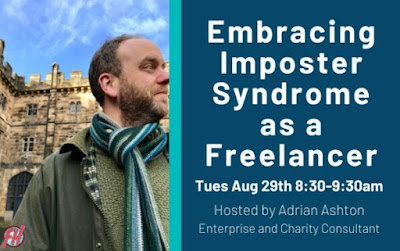
It was therefore exciting and encouraging to have been asked by Freelance Heroes (who are ultimately responsible for my writing the book in the first place), to lead a session to share and explore some of the ideas in my book - in hopes of helping offer fellow freelancers some encouragement and practical ideas for how they might get more out of working as such.


And whilst it's always exciting to share the books' ideas with new people to get their views on my arguments, and what these are based on, I also find it valuable to 'gather some more stories' about people's experience of feeling like an imposter - not just for the sake of possible 2nd edition, but more importantly to share with others through this blog, in hopes that they may be of encouragement to others I'll never meet...


People in the session shared that they'd signed up to it, in recognition of some of the impacts that feelings of self-doubt were having on their freelance careers, and which they wanted to try and do something about:
  • not charging as much as they could/should/(needed to), and so financially struggling more than they recognised that they perhaps needed to;
  • not pursuing contracts or projects that would help raise their profile and secure future work, for fear that they did not hold the right qualifications for it (despite simultaneously acknowledging that they had significant relevant experience).

There was also a key point that one person made about the confusion and overlap between feeling like an imposter, and having a lack of confidence.

It was also interesting and challenging to hear of some of the practices that some of the freelancers in the session had created and adopted, in how they currently deal with feelings of imposterism:
  • phoning a trusted friend for a 'sanity check';
  • adopting a nihilistic mindset, and disassociating themselves from their work, to try and protect themselves against the potential risk of things not working out as they might hope they would.    

As we wrapped up the hour together, everyone shared that they'd found the time together of encouragement, and all committed to take a range of actions as a direct result of it:
  • increase their knowledge about specific areas of their existing work (libraries are always a good place to start for this!);
  • explore and better understand the 'origin stories' of what their doubt about their skill may be rooted in, so that they can design more effective ways to better manage it;
  • create feedback loops with clients and others;
  • talk about these feelings more openly with others, after realising that everyone feels them, to be able to hear others' experiences, and through these, better understand their own;
  • adopt a practice of self check-in questions with themselves when they think they may be feeling it, to help better manage these feelings of doubt and move through them;
  • experiment with different ideas to see which might work best for them (but as with any experiment, always make sure you wear safety goggles, just like when you were at school!).


What also struck me about the session was the number of people who were part of it - normally, on-line sessions and events I've been part of, or heard about, seem to attract (or need to book on) upwards of 15 people - we were a perfectly formed '6', which seemed to naturally allow for everyone to feel they could easily speak, and have the opportunity to explore and directly apply ideas and prompts to their own personal circumstances and situations.

So if you're thinking of joining a session to explore some of these ideas or feelings in the future, perhaps try and avoid the 'sell-out'/'big ticket' types, and hunt out the smaller groups as you'll likely get more benefit and encouragement from them (but only if you're really serious about wanting to do something about feelings of being an imposter...)


Wednesday, August 16, 2023

how to (instantly) lose credibility as a key-note speaker

We've all been to conferences, webinars, and other events where there are headline speakers presented to us in a fanfare of excitement - and we all find ourselves getting whipped up in anticipation of what they're going to say, and then as they're delivering their message/story/challenge, we find ourselves moved to start to take action and make changes in our lives and businesses.

But what if the changes we make because of what these big name people exhort us to, are actually based on lies, and these high-ticket speakers are actually misleading us?


In the last few months, I've been at events where some of the 'big names' touted as to why I should attend them have based their whole arguments on different un-truths, including:

1) it takes 10,000 hours to become an expert in something

2) according to the laws of physics, bees shouldn't be able to fly

And if you're reading this thinking - but those things are true, please ask yourself this: how do you know they're true? Chances are, you believe them because you've heard them repeated by lots of people over time. (This is know as 'the illusionary truth effect'.) I'm pretty sure, you won't haven't researched either for accuracy or published research, because you already believe them to be true so, don't need to fact-check them.


My concern about this perpetuating of un-truths as part of people supporting their ideas or arguments, that they want us to act on is this:

- If you're asking me to believe the ideas you're presenting to me, but the foundations that you're building them on simply aren't true, then:

a) you've shown you can't be bothered to do some simple homework / fact-checking, which makes me wonder what else in your approach is similarly 'lazy'?

b) if you're asking me to trust you by relying on things that have been proven to be untrue, then that's a hard ask...


Reflecting on my own experiences and feelings of when key-note speakers have 'shown themselves up' in this way, I find myself immediately 'switching off' to want to listen to anything else that they're wanting to offer and argue - because I simply feel I can't trust it, and that they obviously don't have any respect for me as their audience. 

Which is a shame, as I also realise I may be missing out on some good stuff that's buried amongst the fallacies and untruths that they're unwittingly perpetuating, which only serves to contribute to false understanding about what we and others might really be capable of... 


So please - any of you out there who are speakers or headline attractions at events: do us the courtesy of showing that you respect us as your audience and fellow human beings, and do a quick check of your facts before you unwittingly succumb to the illusionary truth effect, and tell us do things based on 'facts' that just aren't true (and never have been).


debunking the 10,000 hours rule - 
https://www.6seconds.org/2022/06/20/10000-hour-rule/ 

debunking that bumble bees shouldn't be able to fly - https://www.todayifoundout.com/index.php/2013/08/bumblebee-flight-does-not-violate-the-laws-of-physics 


Monday, July 17, 2023

why freelancers are so (unnecessarily?) self-critical

Reflecting with fellow freelancers as part of a recent networking get-together, we all shared and identified that we're really self-critical and unforgiving of ourselves when we get things wrong - yet are often far more understanding and accepting of others when they do...

My idea about the usual way we can reconcile this, is to do with our not being part of regular teams (in the ways that our salaried counterparts are) - in not having access to appraisals, regular training activities, or all of the other ongoing feedback that can come on a daily basis in micro interactions, we're lacking the perspective to make more sense of our own experiences. And we're more tolerant of others because we don't have the job security our salaried counterparts have, so are more concerned to maintain and protect relationships with have with clients. 

But I think there's actually something else that's equally, if not more, important in understanding this apparent contradiction: because we're not part of a regular team/workplace, we don't get to see all the mistakes other people make everyday that they're either getting away with, or turn out not to be that much of a problem after all.

Without the openness about mistakes and failures, we surely risk entrenching ourselves in echo chambers of our own mistakes - with no recourse to judge how far our errors and lapses really are that 'bad' in comparison to other peoples', we'll increasingly and unnecessarily chastise ourselves to our own detriment?  

Tuesday, July 4, 2023

all business owners and entrepreneurs should do car-boot sales once in a while

Some readers of this blog may recall that in the past I've written about how I try and keep my hand in at running a market stall from time to time...

But recently, I broke my car boot virginity, and with my wife (who's a more seasoned pro at these things) filled the back of the car and set off at crazy o'clock in the morning to unload the contents in a field alongside others, in hopes of being able to generate a few quid from things which we can't offer a home for anyone - but which we thought might still be of value and enjoyment to others.

And whilst standing in a field all day, hoping that passing strangers will stop by our pitch and help us not have quite so much stuff to re-pack into the car at the end of the day might not sound that appealing to some, it was an experience that I'm glad I indulged in (and will probably try and do again in the future):

- it highlighted the changing patterns in our society of how we consume/do business: for example, no-one buys CDs and DVDs, because these media are now available on streaming services;

- it re-enforced how hard it is to sell clothes (however cheaply you offer them), as fast fashion makes it so easy to buy on line (and have option to return without cost);

- and it also evidenced how increasingly time poor people are: comments from people in our neighbouring cars and pitches who've been doing it regularly for years, all agreed that there are far fewer people browsing than used to.


But, having a pitch at a car boot sale also reassured me that as much as things are changing (see above), some things will remain as true today and tomorrow as they did when I was a kid - 

* parents are always keen to encourage their kids to get into reading actual physical books;

* cash retains a place in how we do trade;

* and we'll always want an ice cream from the van...


Monday, June 5, 2023

being all things to all people - the realities of being self employed and an unpaid carer

This post was written at the start of carers week 2023 - and is based on conversations amongst freelancers and owners of small businesses at events hosted by Freelance Heroes and Atomicon23.

It is not intended to offer definitive, medical, or legal counsel or guidance - but reflect emergent themes and issues that may be of encouragement and support to others; and possibly also highlight future wider policy development needs. 


My name is Adrian, and I'm an unpaid carer for my adult step-child, as well as being a freelance business consultant.

In my head that makes me sound like I'm at an alcoholics anonymous meeting, but maybe it's not too dissimilar: people often struggle to feel comfortable in knowing how to best behave in the company of an alcoholic, and similarly with someone who's an unpaid carer (unless you're living it day to day, it can be hard to fully appreciate the realities of the identities and roles that you hold and manage as such).

But unlike my counterparts who are in salaried, direct employment, there are no legal recognitions for me as an unpaid carer in my (paid) work; and no data on how many other people like me there are - in preparing to host the roundtable discussions that this blog is based on, the Office of National Statistics, the Labour Force Survey, and ipse all revealed that there is no data about how many people who are self-employed/business owners are also unpaid carers. 

A rough-cut extrapolation of data I could find about unpaid carers in general, and different models of employment, might seem to suggest that roughly 10% of the self-employed are also unpaid carers (that's about half a million people!), and of those, less than 1 in 10 have access to any support for themselves in these roles - and as freelancers, we're more likely to be in poverty if we're an unpaid carer than if we were salaried.

Starting to initially explore these issues with groups of fellow freelancers, small business owners, and sole traders who are also unpaid carers like me, saw the following emerge and being shared:


Busting accepted wisdom about origin stories

It can be easy to assume that people who are unpaid carers chose to become self-employed to offer themselves more flexibility around their unpaid caring role - but what came out of the discussions, is that this wasn't always the case.

Often, people took on the mantle of an unpaid carer role after having been self-employed for many years, and as a result subsequently found they needed support with redeveloping how they worked in order to be able to maintain their earnings to continue to support themselves and their families (but this isn't offered/available to them).


Seeing it coming

In one of the roundtables, a person shared how they had joined the conversation to learn from others' experiences because they had recently recognised that in future years, they will need to be more actively involved in supporting the care of their parents. 

They were trying to be pro-active in managing the impact that becoming an unpaid carer would have on themselves, their family, and their business by better understanding the likely realities they will experience when they do. As a result, they hoped to be able to best plan to mitigate the impacts of this - and this roundtable had offered them the first opportunity to be able to do this in any meaningful way.


The need for a better handbook

Through sharing their experiences, people agreed that there was much about being an unpaid carer that they wish they had know sooner, but which no-one had told them (for example - the benefits of being able to be formally recognised and registered as a carer for a family member). 

While there is knowledge out there, it can be hard to navigate and identify ("you don't know what you need to know, so don't know what questions to ask").  People are frequently relying on friends and family for informal (emotional) support for themselves, but as encouraging as these people might be, they rarely know of practical and pre-existing systems and processes that unpaid carers can apply to, but often aren't told about.


The limiting of business growth and potential

A common recurring practicality about being an unpaid carer that was shared, was how it meant that the businesses we had created all had to be limited in terms of their potential to grow in order to honour our caring responsibilities - and with that, our ability to innovate and develop new services and offers in the marketplace.

Whilst this is obviously a personal decision that all unpaid carers find ways to eventually reconcile, this speaks to the impact of the need for unpaid care to our wider economy.


The cost to our personal futures

As well as the financial impact that being an unpaid carer creates through loss of earnings (which is not mitigated through carers allowance were it is able to be awarded), there was also concern about how little support there is for us to be able to access for ourselves in this role - one person shared how becoming an unpaid carer had led to them being diagnosed with mental ill health, and being subsequently needing to be prescribed anti-depressants.

The emotional stresses that unpaid care places on us therefore also affects the future we might have otherwise experienced for ourselves, through it is affecting our well-being today. 


The need for supportive clients

A tension was briefly explored around our relationships with our clients as small business owners - specifically, how far we're open with them about our identify and priorities as an unpaid carer, and how this tension can be managed in how we work with them. As freelancers, our clients come to us to solve problems quickly, responsively, and without adding to their own existing complexity, so revealing we may need to drop them at no notice because of a caring need, may understandably 'spook' them a little...

People shared how their clients were generally sympathetic and flexible in work agreed - but not every business that commissions us will be able to be such; which loops us back to the limiting on our business' potential that being an unpaid carer can entail.


Taking back control

Being self-employed often means we face a barrage of external stressors because of the ever-changing circumstances we all experience that are instigated by others (clients, government, etc) - and being an unpaid carer only exacerbates these through the additional unknowns of how the child, parent, or sibling we care for may respond on any given day to any given event, how reviews of their care or support plans may trigger new complications, and so on.

The roundtables therefore also tried to look at how we're approaching supporting ourselves, and in doing so, gain a little more control over our own lives:

- counselling support from the FSB was mentioned as one of their member benefits, that one person had made use of;

- one person shared how they had chosen to deliberately limit the earnings of their business to reduce the stress on having to work with multiple clients on different deadlines which would otherwise be constantly competing with the needs of their child, that they are the unpaid carer for;

- taking out a private health care plan to be able to arrange GP appointments, any procedures, etc at times that suited them, rather than playing the lottery of NHS scheduling and waiting lists, was shared by someone else;

- registering as a limited company, rather than remaining a sole trader, was shared as a way one person had approached reducing the stress they were feeling about the risks in their business alongside being an unpaid carer.


But these roundtables weren't all 'doom and gloom' as might start to be otherwise interpreted based on the above:

- there was also news about 'Cornerstone', a new emergent peer community for freelancers who are also unpaid carers being created;  

- gratitude was expressed for people having the opportunity to (briefly) share time with their peers, and be edified from hearing that what they were experiencing wasn't unique to them; 

- and people also valued how being an unpaid carer creates space for us to reflect on our own personal identities as human beings.


If you're an unpaid carer you may find the below sites of help (as well as links in the various parts of the blog above):

https://www.citizensadvice.org.uk/family/looking-after-people/carers-help-and-support/

https://www.gov.uk/browse/benefits/help-for-carers

https://www.carersuk.org/help-and-advice/

I'm also happy to offer to speak with any fellow small business owners, sole traders, and freelancers to swap stories that may be of mutual benefit - as well as with any sector or national bodies to further explore potential policy and initiatives that may address some of the themes and issues these roundtables identified:

- the impact to the economy of 500,000 businesses not being able to achieve their potential;

- the need for business disruption to be avoided when small business owners transition into unpaid care roles;

- how freelancers can be better supported to access support/avoid poverty when becoming unpaid carers.


UPDATE 3rd AUG 2023:

Published after these round tables, and blog was written up, JRF have undertaken some further research into this, and found that as unpaid carers who are also freelance/self-employed/small business owners, we pay a #CaringPenalty (suffer lost earnings) of nearly £10,000 every year!
- any wonder so many of us are finding ourselves being pushed into poverty?

Thursday, June 1, 2023

I'm always trying to be a better conman

One of the recurring pieces of feedback I get from many of the people and organisations I've worked with, is how they've enjoyed how the ways in which I've enabled them to create the changes they've struggled to achieve, but always aspired to.

And got me thinking about what the 'secret sauce' is that I always try and use, and bring to every project and contract I'm involved with.


I've realised it's all about my being a con-man:


Con(findence) - modelling behaviours and actions myself, to inspire and encourage others in turn; so that they might be able to reach further than they thought they could, or felt brave enough to.

Con(nections) - we all rely on other people to varying degrees for everything that we want to achieve and enjoy in this life. I'm always happy to share contacts in my network with others to try and create some serendipity whenever and wherever possible. I also recognise that I'm mortal, so at some point, people will need to know who else they might be all to call on in the future... 

Con(viction) - life is hard and unfair. We need to keep finding ways to motivate ourselves, which is why I try and only get involved in work that I think is meaningful in some way, and creates benefit for others. Part of how I work is wanting to find ways to get excited about the things I find myself involved in.


So there it is - I'm a conman, and that's probably a good thing for the people who ask me to share some of their journeys and adventures with them.