Showing posts with label learning. Show all posts

Wednesday, February 19, 2025

What does my business need next, after 20 years?

I'm increasingly coming to the idea that most training, workshops, seminars, events, etc, that are created for, and aimed at, freelancers and the self-employed like me, seem to usually be focussed on those people either thinking about, or having recently, started out in this way of working.

That little which isn't, seems to be focussed on how we can build our 'evergreen content' into a passive training course that people click to watch, with an occasional mastermind session that would allow me to work less (and so be involved with less things that impact the world, as much of my client work offers me opportunity to), and charge people more (and so excluding people who may otherwise benefit, but simply can't afford to, through no deliberate fault on their part).


This year is the 20th anniversary of my 'striking out' as being self-employed/freelancing, after I was 'stitched up' by one of the then leading national social enterprises in the UK who'd just encouraged me to relocate my family to the other end of the country - to take up when they promised was a dream career offer that they were creating for me, but turned out to be nothing but well meaning intention when it came to allocating me a desk...

And over the last 2 decades, it strikes me that most of the CPD events I go to are now on a loop of those profiled in the opening of this post.

And that's not automatically a bad thing - I recognise that very few businesses of any type get to this porcelain milestone, and in one of the chapters in my book about imposter syndrome, I detail how realising that you're in such training events (and not getting any apparent benefit from doing so) is a sign that you really are doing alright in how you're running and managing things in your work.


But... I don't want to get stale/complacent - the way that I've always approached designing, and revisiting, how I work is based on trying to keep me constantly moving forward, challenging my understandings and ideas, and ultimately trying to avoid falling into habits I see in other consultants and advisers, which are ultimately only to the detriment and cost of the groups and enterprises who have looked to them for support and guidance... 

And I'm also aware that I'm not in the same place I was when I started out 20 years ago - I'm now an unpaid carer for several immediate family members (so no longer have the same amount of time available to devote to my business or earn money, but aren't eligible to apply for any support for myself in these roles), and also no longer own a house nor have the savings I used to (which had been forming the basis of how I imagined I'd fund my 'retirement', which is looming in the next 20 years).


So - where should I be looking for the next 'good stuff', as I now start to think about my next 20 years in business?*


* (assuming that there's still no-one out there who'd be open to putting me back onto a respectable payroll? I never meant to be self-employed, and am still not sure it's my life's calling..) 

Friday, January 3, 2025

after 20 years, it's time to go to the toilet

My business is 20 years old.

20 years! Only about 10% of enterprises that start-up get this far. 

To put this in perspective - when I started out, smartphones didn't exist! (it would be another year before the first tweet was posted; 2 years before the first iPhone was released on the world; and 3 years before Dropbox was launched. The typical best internet speed was 1Mb compared to around 900Mb today - we had to rely on using sharpened bones to scratch messages onto stones, and then hope people picked those stones up when we threw them at them).


Now, it turns out that the material associated with this particular anniversary is porcelain - something that most of us here in Britain associated with toilets.


But for me to have gotten this far, porcelain actually seems an apt simile for me:


  • it has a high elasticity - to be able to keep up with all the changes in the world over the last 2 decades, the range of work I do, and types of organisations I support across all sectors, means I've had to be able to easily keep stretching myself.
  • it has considerable strength and hardness - I've pushed hard on some things over the years, often to personal and professional criticism and opposition. This includes: (successfully) challenging CIC legislation; publishing a book that exposes most of the claims that people make about 'imposter syndrome' to be unproven and/or not based in any factual evidences; shining a brighter light on the 500,000+ unpaid carers who are discriminated against by all the bodies that are supposed to be supporting them because they're the only type of carer who aren't recognised in law for the sole reason that we're also self-employed; and calling out the apparent unprofessional practices of some social investors, which are damaging the wider sector; to name but a few.  
  • it's translucent - I've openly published details of how I'm creating (or not) impacts of different types each year; and also been honest in my blog posts about when and where I've gotten things wrong.  
  • and it has a high resistance to shock - if you've followed my blog over the years, you'll know that since becoming self-employed, my family has been made homeless twice; my father (who lives at the other end of the country) has almost died twice; I've navigated a difficult divorce; been investigated for tax fraud by HMRC three times (and cleared every time); had 'unannounced police visits' late at night; and so on. So much so, that the few people who know just how much 'shock' I've had to respond to and work through over these last 2 decades, are all amazed that I'm not only still in business, but not needed to be admitted anywhere...

So I'm actually pretty chuffed to be associated with porcelain.


But I also didn't want to miss the opportunity to try and mark this milestone - so, linking back to the toilet analogy, I've decided to twin my office toilet with a school in Uganda via 
https://toilettwinning.org/


25% of all human beings today don't have somewhere safe, clean, and hygienic to go to the toilet. Not only does this create all sorts of associated 'bio-hazards', it strips fellow people of their dignity. And if schools don't have toilets, then kids will find ways not to go there for those reasons, and as a result, lose the chance for education and so lose the future that they could/should have had, including the opportunity to break generational poverty.


So the next time you're paying a visit to the loo this year, please think of me and what you might be able to do to similarly 'be more porcelain'; and maybe if you might also be able find a similar excuse to twin your toilet with someone else's. 

Thursday, November 7, 2024

does freelancing make you a better lifelong learner?

We're currently in the middle(ish) of this year's Lifelong Learning Week - an annual campaign to highlight the importance of continuing to exercise our 'little grey cells' after our school years, and shine a light on the various benefits that doing so creates for us personally, those around us, and the wider communities and worlds we're part of.

As a freelancer/self-employed, I've always prioritised maintaining an ongoing and active learning mindset:

  • I set targets for how much of my turnover I try and spend on courses, journals, and events;
  • I keep a rolling monthly log of all my formal CPD activities, to help reflect on what I've taken from them, and how they've contributed to how I've challenged/changed my thinking and practices;
  • I hold memberships of bodies like the Workers Educational Association and the Co-op College, as a show of solidarity with providers of lifelong learning;
  • and more...

But I was struck this year that only 52% of us 'adults' have engaged in any type of recognised learning activity in the last 3 years, and that there are growing inequalities in the opportunities and abilities for some of us to even have the option and opportunity to engage in learning activities : https://learningandwork.org.uk/resources/research-and-reports/adult-participation-in-learning-survey-2024/

Reflecting on my own 'learning habits', and hearing about those of fellow freelancer and self-employed types through different communities I'm part of (such as Being Freelance, ipse, FSB, etc) makes me realise that perhaps there's something about working in this way which helps to address some of these barriers and inequalities that we all face when it comes to lifelong learning.
Maybe because we recognise the importance of always investing in our skills and knowledge (we'd quickly become obsolete and lose work if we didn't!), and because of this, more easily 'catch the learning bug'?

And if so, should we make this part of how we celebrate and evidence just how important we are to the wider economy and communities, as another example of how underrated and undervalued we are to policy makers and politicians? 

Monday, May 20, 2024

Whatever happened to Social Firms England?

When I first started working in the social economy (a time before the likes of Social Enterprise UK, Locality, and Unltd), there were already some well established bodies - including what become known as Social Firms UK.


It emerged in the 1990s, when there were a series of European funded programmes across the country that explored how businesses could create and sustain employment for people with a disability as part of their ongoing business model - at that time, a revolutionary concept.

And it its early years, it undertook pioneering research, lobbying, and policy work that's influenced the rules we see today that mean there's greater recognition and support in the workplace for people with disabilities; quality standards such as the disability confident employer; and also that bodies such as Social Enterprise UK now exist (Social Firms UK was one of its founding members).

Ultimately, it's responsible for the recognition that a legitimate purpose for any social enterprise is to create and sustain employment for people who find themselves disadvantaged and discriminated against in the labour market through no fault of their own or choosing (the 'social firm' model of social enterprise). It also amassed an enviable resource library of case studies, research, and guides, for any 'social firm'; were involved in some of the first national programmes to deliberately create social franchise models to help scale the reach and impact of the sector; and also developed one of the first national sector toolkits for reporting social impact.


But in recent years, its fortunes have waned - it launched its own accreditation standard, the Social Firms Star, which few enterprises adopted; and as part of the devolution agenda, separated itself into Social Firms England, Social Firms Scotland, and Social Firms Wales.


I realised recently that I'd not had anything land in my inbox from Social Firms England for a few months, so looked them up, only to find that it has been dissolved in March 2023 - with no announcement to their email list, social media pages, or any other media outlet. Looking at their last accounts, it seems that it had increasingly struggled financially to be able to maintain itself.

Across the other regions, Social Firms Scotland merged with SenScot (the Social Enterprise Network for Scotland) in 2021, although SenScot itself now seem to be struggling on the basis of their last filed accounts, and that their website domain is no longer is use?;

however Social Firms Wales still seems to be actively continuing to offer support to the social firms model of social enterprises.   


So I'm left wondering, whatever happened to Social Firms England - it was one of the pioneers of the modern landscape of the social enterprise ecosystem today, and also held a lot of valuable research, knowledge and learning that would still be of interest to individual ventures, as well as bodies looking to better support the sector as a whole.


Does anyone know where those resources may now reside, and why, unlike with other social enterprise infrastructure bodies, there was no announcement, reflection, or celebration of the impact it had had on the wider sector over its lifetime? 

Monday, February 19, 2024

Qualified, Certificated, and Accredited imposters

Feelings of imposterism are commonly associated with feelings and thoughts that “we’re simply not good enough” – and there are lots of ways through which people generally try and manage these.

But most of these advocated approaches tend not to involve people engaging with formal study or learning, in pursuit of ultimately gaining a recognised qualification of some type, with which they might then beat their inner imposter over the head with.


I’ve also noticed that although feelings of imposterism can surface in any of us, in any role, and at any time in our lives, it seems to be more concentrated were people have roles with higher levels of responsibility – yet part of the gaining such roles is, in part, based on evidenced learning on the part of the candidate, in the form of increasingly higher levels of certificates and accreditations (which are supposed to be proof of our abilities to undertake such roles and tasks).

And this is odd because feelings of self-doubt can often be rooted in our feeling we lack sufficient knowledge or experience in a subject field – something which qualifications are surely designed to offer us? So what’s going wrong in our current structured learning pathways not automatically resolving the tension in how we believe in ourselves after being awarded our shiny new certificates?


I wonder if it may be to do with the fact that courses which offer us a route to gaining a recognised qualification aren’t often that connected to how well we feel we can subsequently do our jobs?

The process of accreditation is usually based on a learner being able to evidence that they’ve gained knowledge and been able to apply that knowledge in a given situation. And the criteria by which they are assessed in doing so are linked to overarching national standards.

But having created accredited programmes (and been through a fair few) myself, there’s something that I realise has been missing in all of them: there’s no standards or frameworks about how we as learners are reflecting on, or building, our confidence in the subject matter. There are no prompts for how we emotionally feel about the knowledge and how we might be subsequently using and applying it. And without those tools to help us relate to our learning through our feelings, as well as our intellect, qualifications don’t help us in any meaningful way
in challenging feelings of inner doubt.

And perhaps this is why most of the guidance out there about how we can try to approach managing feelings of self-doubt don’t often seem to promote a person committing to a programme of formal certificated learning as a way to bolster their self-esteem and belief?


So – in summary: just because a person is qualified, doesn’t mean that they’re automatically going to be any more confident in their role; and if you’re supporting someone through a course of learning, try and help them to explicitly consider how their confidence and self-belief in themselves is being bolstered and enhanced through the new knowledge they’re getting. It may help us all to beat those inner imposters collectively better over the head…

Wednesday, September 6, 2023

why not being an academic means university students get more benefit from my teaching

Over the last 25 years or so, I've found myself approached from time to time to speak as a guest / associate lecturer within within various universities and faculty schools. And sometimes, I've also been asked to help design new degree course content around themes of social entrepreneurship; social innovation; and there's even a podiatry degree that now has an enterprise start-up module in it thanks to me!

The feedback is always that students enjoy my sessions, and they seem to get more out of them than they do in their usual taught syllabi (a group of students who were part of a startup bootcamp I was part of told me that they'd gained more useful knowledge from the 2 day sessions I'd delivered, than they had from the last 2 years of their business degree!). 


However, despite this consistent appreciation and validation from students, I'm sometimes not invited back...

So there's obviously a dilemma here: students enjoy it, but the university doesn't.


This relates to the old-school marketeers story of the bakers dilemma: understanding that your customer and consumer are often two very different groups of people, each with their own divergent expectations and needs: 

- students want new experiences, they want to learn in new ways, they want to develop their own critical skills in new ways;

- but further and higher education is a regulated teaching context, where curriculum content has to be covered, and assessed in pre-determined ways.


I'm therefore always trying to walk the line between ensuring a university is able to ensure compliance with its teaching requirements, but at the same time, students get an experience different to what they might usually enjoy.


But I also recognise that I'm not 'academically gifted' in the traditional sense: I scraped through school with a clutch of GCSE passes; similarly limped through College with only 2 A-Levels just about passed; and was only offered a place at a business school through clearing (which subsequently saw me graduate with a 'Desmond'* after 5 years) - but I've since gone on to create, co-design, and develop curriculum content and modules for a number of universities and international colleges; influence national policy and company law, etc. 

And all of this means I carry a prejudice and bias about how I see the value of taught curriculums and formal education - but in turn, this means I'm more emboldened to take risks and do things very differently to how students might usually experience learning in academic institutions. And it's this difference that they seem to appreciate and enjoy: having someone who not only talks about how things can be done differently, but physically models this too, encourages them to re-examine their own wider learning and how they are engaging with it, and in doing so, get even more value and benefit from it.


* if you don't know what this is, then I'm obviously far older than I'd like to think I am for making this cultural reference...

Wednesday, August 16, 2023

how to (instantly) lose credibility as a key-note speaker

We've all been to conferences, webinars, and other events where there are headline speakers presented to us in a fanfare of excitement - and we all find ourselves getting whipped up in anticipation of what they're going to say, and then as they're delivering their message/story/challenge, we find ourselves moved to start to take action and make changes in our lives and businesses.

But what if the changes we make because of what these big name people exhort us to, are actually based on lies, and these high-ticket speakers are actually misleading us?


In the last few months, I've been at events where some of the 'big names' touted as to why I should attend them have based their whole arguments on different un-truths, including:

1) it takes 10,000 hours to become an expert in something

2) according to the laws of physics, bees shouldn't be able to fly

And if you're reading this thinking - but those things are true, please ask yourself this: how do you know they're true? Chances are, you believe them because you've heard them repeated by lots of people over time. (This is know as 'the illusionary truth effect'.) I'm pretty sure, you won't haven't researched either for accuracy or published research, because you already believe them to be true so, don't need to fact-check them.


My concern about this perpetuating of un-truths as part of people supporting their ideas or arguments, that they want us to act on is this:

- If you're asking me to believe the ideas you're presenting to me, but the foundations that you're building them on simply aren't true, then:

a) you've shown you can't be bothered to do some simple homework / fact-checking, which makes me wonder what else in your approach is similarly 'lazy'?

b) if you're asking me to trust you by relying on things that have been proven to be untrue, then that's a hard ask...


Reflecting on my own experiences and feelings of when key-note speakers have 'shown themselves up' in this way, I find myself immediately 'switching off' to want to listen to anything else that they're wanting to offer and argue - because I simply feel I can't trust it, and that they obviously don't have any respect for me as their audience. 

Which is a shame, as I also realise I may be missing out on some good stuff that's buried amongst the fallacies and untruths that they're unwittingly perpetuating, which only serves to contribute to false understanding about what we and others might really be capable of... 


So please - any of you out there who are speakers or headline attractions at events: do us the courtesy of showing that you respect us as your audience and fellow human beings, and do a quick check of your facts before you unwittingly succumb to the illusionary truth effect, and tell us do things based on 'facts' that just aren't true (and never have been).


debunking the 10,000 hours rule - 
https://www.6seconds.org/2022/06/20/10000-hour-rule/ 

debunking that bumble bees shouldn't be able to fly - https://www.todayifoundout.com/index.php/2013/08/bumblebee-flight-does-not-violate-the-laws-of-physics 


Thursday, December 8, 2022

It's that time to get nostalgic again

So, here we are - it's the end of another year, and traditionally a time to reflect and reminisce about the period that's just been since the last time we did this: what we've learnt, what we wished we'd known sooner, and the hopes we'll take with us into 2023...

Previously, I've approached this through looking at what generated the most interest/uproar across my social media channels, but this year I had the opportunity to spend a morning with fellow facilitators as part of an informal process with Paul Kelly and Caroline Jessop of IAF England and Wales fame.


Everyone in the session all seemed to agree how well structured it was, and how expertly guided we felt we'd been (possibly with the exception of Paul's ever-changing Christmas jumpers), and whilst others will be sharing on their own blogs, etc their views of it, I wanted to capture the reflections I took from it about myself and my business over the year that's been 2022, here: 


CPD

I realise that the most beneficial things I've found this year with regards to my own professional CPD have been:

1) getting interviewed for various people's podcast series and radio shows* - it's a fascinating way to reflect on what I think I know, how I came to acquire this 'special knowledge', how it's influenced and continues to influence how I think, and so much more...

2) start a TikTok channel - like with interviews, it's such a wholly different way of having to approach how you think you know what you do; and with so much encouragement to indulge your creative impulses, I can see why some people are so deep into this social media channel...


NETWORKING

We often think of (formal) networking as a semi-regular forum or group we check-in with either virtually or in person. And reflecting on my involvement with several over the year has reminded me how important they are as a source of mutual and emotional encouragement.

However, it also struck me that as valuable as such support is, it's usually with the same people (otherwise it wouldn't work) - what I've also experienced this year are a couple of 'exceptional events' (including being asked to draft an opinion piece on why CICs may have been the worst thing to have ever happened for the social enterprise movement, by an international media agency). These generated new opportunities to meet and speak with people who would normally be outside of my circles, and only with hindsight do I realise how reactionary I was in exploring these (note to self: be more organised and methodical next time!). 

And whilst these new contacts are exciting, they're as equally scary (owing to the pay grade that some of these people operate at!), so knowing that there's a community I can check-back in with for some encouragement and assurance around them is important also... 


WALKING

The session concluded with trying to look forwards, having now looking back - and generating an analogy for what we want to achieve in our business over the coming year.

Mine turned out to represent how I've always tried to approach my professional ways of working - walking:

- it's intentional; is recognised in supporting our well-being; allows us to explore new places; and has moments of serendipity in the people we encounter as we travel in this way.

- But of course, there's also a balance to this in that walking also always includes a risk that we might get lost, or find ourselves ill-prepared for rapidly changing circumstances (such as it starting to rain, but when we left it was sunny so we didn't bring a coat or brolly...)


Overall, it was a morning I'm glad I invested in with my peers, and will definitely be looking out for opportunities to again when the end of the years start to roll around again in 2023, 2024, 2025...


* podcasts and radio shows I've appeared on this year:


Thursday, August 25, 2022

being an enlightened guides and encouraging fights - the secret to CPD as a facilitator?

I recently had the opportunity to spend some time with a group of facilitators who weren't only at different stages in their careers, but also in different countries, and worked in very different contexts, to each other.

Our excuse for giving up an hour and half in our day for each other was to share together how we approach our professional development - in hopes of spotting new opportunities and options, considering how well our current practices still meet our needs, and sharing some encouragement with each other (most facilitators are self-employed/freelancers, so it can get lonely sometimes...


The (unexpected?) key theme that emerged from our sharing of stories together, was that as facilitators all of our CPD should be geared to how we grow and develop as people, and how that in turn affects how we build relationships with other people in being 'emotionally available' - rather than the usual assumption of it being based on acquiring specific pieces of knowledge or technical skills.

This means we're more likely to engage and invest in counselling and therapy, in seeking to become more of an 'enlightened guide' as a facilitator, rather than a technical expert in a process (which may or may not always be relevant to the needs of the people we find ourselves working with to support).


But we also recognised that there were bags of 'practical stuff' that we need to know from time to time - and with the complication that we may not always know what those things are with enough lead time to be able to plan them into our schedules and diaries.  As a result, we do a lot of "dynamic iterative orientation" (aka learning on the job with a little help from google, and then trying to find time to reflect on it all afterwards).

This point about reflection also came out strongly - and whilst we all feel that we're encouraged to journal about our learning, some shared that this approach simply doesn't work for them. However, just because we're not recording or capturing that reflection in any way, doesn't mean that it isn't happening and we're gaining from it.


There were also other approaches shared that wouldn't seem out of place in any other profession:

- reading whilst travelling (on a train obviously, it would be irresponsible to try and read and drive at the same time)

- LinkedIn learning

- trying to schedule regular times to reflect, and in doing so build better habits for investing in ourselves


And if we could open a time tunnel to send just one message or idea back to our younger selves about what we wish we'd learnt, realised, or invested in sooner with regards to our professional practice as facilitators:

- don't think you have to design a detailed process: it's better to keep things simple

- remember that getting a successful outcome with a group isn't all on you: the people in the room are equally (if not more) important in the process

- start learning about sketch notes earlier

- find more opportunities to be an 'understudy'/back-up facilitator to others

- it's OK to not only allow, but also encourage, conflict between people: it can enable them to better work though issues together, so that they can find resolutions and consensus that they can better agree and commit to, and then engage more fully in the wider outcome being sought to be facilitated

- be more honest and open about how we feel

- dance more (to feel good, not to look good)

- keep finding times to reflect, and especially in 'step away' spaces where there's less risk of distraction


Hopefully, the above captures the core of our discussions, but I'm sure others who were also there will add comment to this to correct, clarify, and contribute further where it's needed.

And if you're interested to get more insight into the practices, people, and places of facilitation, free free to drop by any of the International Association of Facilitators England and Wales' regular meetup calls that are hosted throughout each month - no charge to join, and no need to be an IAF member either!


Monday, August 22, 2022

turns out I may have been right about CICs ever since they were first introduced!

13 years ago I posted my first blog about my ideas relating to the much hyped (and sometimes fetishized) legal structure for social enterprises, the Community Interest Company.

But I've been interviewed about CICs for other people's podcasts and blogs since before that (2006 seems to be the earliest reference I can find to my name or voice in someone else's on-line space!)

And in all of these posts, there's a bit of a common thread: a concern that this legal form may not be everything that most people make it out to be, and understand it can do for you - and how the Regulator for them may not always be that au fait with them either! And all of these positions are based on multiple published sources of evidence and research.

http://thirdsectorexpert.blogspot.com/search/label/Community%20Interest%20Company


Every conversation I've subsequently had with individual social entrepreneurs and/or social enterprises about this form ends up the same way: with those people asking why anyone would ever want to be one?

But over the years this 'open questioning' about what the actual benefit and relevance of the CIC form might be hasn't been without fall-out: I've seen people professionally attack my reputation, sector bodies unofficially blacklisting me, and some regulatory bodies opening files on me...

Yet the edict of "CICs are great - keep setting yourself up as one" seems to have continued over this intervening 15 year period. Until now.

Because now, national social enterprise media are starting to share the data from the CIC Regulator that I've been looking at over the years, and like me, starting to ask questions about how fit for purpose this form really is.  You can read the full Pioneers Post feature over on their website (https://www.pioneerspost.com/news-views/20220812/community-interest-company-closures-72-latest-financial-year), but I've collated their key charts from the piece below which seems to reveal something of a trend - even allowing for "pandemic exceptions" that might otherwise be skewing the data:


* the number of CICs being wound up each remain seems to remain pretty steady at around 12-15% of all all CICs - which suggests that there's a consistent notable proportion of people who are adopting this form, only to realise it doesn't work for them;

* the growth rate in CICs seems to be falling over time.


Which take me back to the title of this post - despite not being a qualified solicitor or statistician, it appears that everything I've ever posted, and talked about, in relation to this legal form has been right after all!


But so what? I'm still hearing lots of people who are being wrongly advised about this legal form and what it can offer them, despite all the evidence and research to the contrary that I've been openly sharing for over a decade.

This is perhaps where you can help, as the reader of this post - please consider sharing it to your contacts and networks through social media, etc: not as any form of endorsement of my ideas, but in hopes of continuing to widen and further this conversation....


Monday, June 6, 2022

I changed my mind about kindle-ing my book

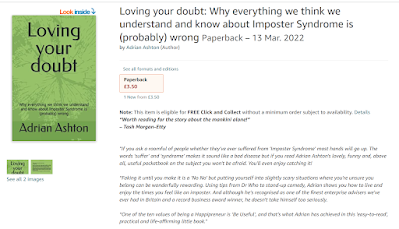
Earlier this year, I published my first book - on the topic of why everything we think we know about imposter syndrome is (probably) wrong, after I started to look at the research and evidence associated with this issue.

And at the time, I decided to invoke authors prerogative, and only make it available as a physical book - and as part of my sharing the why and how I'd come to accidentally write this book and put it out into the world, I also shared my reasons for this choice.

However, as some may recall, I've shared in previous blog posts how I'm always open to 'being proved wrong' - and this foray into the world of being a published author is no different.

Since the book went 'live', I've had a couple of people ask about an eBook/Kindle version - and I've always politely referred them to the blog post giving the reasons why it was only available in physical form.

But then someone challenged me on this with actual evidence and arguments. And given this is my first time in book publishing land, and I'm largely feeling my way as I go along, they were things which I'd honestly not considered in my original thinking (accessibility issues, import taxes between countries, potential for climate impact, and more opportunity for spontaneity).

So, I've 'relented' and made a copy of the book available as a kindle eBook. 


The reason it's the same price as the physical copy remains true to my original thinking about what to price it at, and I've also allowed for it to be shared between people in the same way you can if you buy a physical copy.

So, if there's moral to this story, it's probably that you should always reach out to authors if they've not done something that you might have preferred/like them to; and that Suzanne Whitby is really good at challenging your thinking (it was her arguments that finally 'tipped me' over to the eBook side...) 


http://thirdsectorexpert.blogspot.com/2022/03/i-did-book-thing.html

https://thirdsectorexpert.blogspot.com/2011/11/its-great-to-be-proved-wrong-really.html 

https://www.amazon.co.uk/dp/B09V25N8G6

Thursday, June 2, 2022

maybe I am ok with being a 'guru' after all...

10 years ago, I publicly posted in a deliberate attempt to distance and separate myself from the title of 'guru' that others were (and still are) referring to me in association with, for my work with enterprises, charities, businesses, sector bodies, and educational institutions of all types - https://thirdsectorexpert.blogspot.com/2012/07/on-being-guru.html

However, a recent conversation prompted my revisiting my understanding and definitions of the word "guru", and I've now come to associate this title with a person who's a popular expert / influential teacher. And on this basis, I now feel comfortable to 'don the mantle' of being a guru: 

  • I'm happy to be known as an expert and teacher (after all, those are the bases on which I 'sell myself', and people extol my virtues through posts on social media and recommendations left on my LinkedIn profile);
  • similarly, based on comments people make about me, and the followings I seem to have amassed across different social media channels, I would seem to have garnered a degree of popularity (although I never meant to!);
  • and I also know my work has changed policy, legislation, created jobs for others; so I can say with confidence that I've had influence.

So - I'm now ok if you want to call me a guru, but my next question to figure out, is what am I a guru of...?


Monday, May 16, 2022

"I couldn't tell who was in the room, and who was on zoom.."

Last weekend, I was part of supporting a hybrid conference - which was about how we 'do' hybrid (hope that's not too meta of a concept to open a blog post with?)


As a facilitator who's part of the IAF England & Wales team, earlier this year we were considering how to re-assert ourselves as a body of practitioners, and also re-spark our community of facilitators, after being without our customary annual conference for the last 2 years (Covid, and all that). 
Someone (possibly me) suggested that we do it as a hybrid event - giving us the chance to share, try out, and learn from others how we do events where people are both 'roomies' and 'zoomies'. 

And while there's lots of other posts people are making about their experiences of it across social media, expressing how having it as hybrid was far more enjoyable and engaging than many were fearful it would be otherwise, I wanted to pause to reflect on my experience of leading a session about how we do networking in hybrid ways.

Given that we all know (in theory) how to do networking in person, and we've started to feel our way with it on-line in breakout rooms, etc over the last 2 years of pandemic, I wanted to try out the notion of doing it 'hybrid' - where the people networking together are both on-line and in a room at the same time.


I also wanted to explore some of what each side felt like they were missing out on, in not being in the others' physical/virtual space. 
So, as part of the session, I posed a flipped question to both groups - what did zoomies feel they were missing out on, by not being in the room; and what did the roomies feel they were missing out on by not being a zoomie.

Interesting, there were lots of frustrations and FOMOs expressed on both sides, but in 'headline':

- if you're on-line in a hybrid event, you miss the spontaneity and potential for physical contact with other human beings;

- if you're in the room at a hybrid event, you can feel more vulnerable and at risk from not having access to your usual home comforts, and having less recourse to being able to 'get out' if you feel they need to.


So - some good learning that highlights that not everyone is keen to rush back to doing everything in person (or if we are, we need some careful considerations). 
And there was also lots of other great learning throughout the conference about the realities and practicalities of both managing, and being part of, hybrid events.
(SPOILER: despite our not spending any money on tech, and the venue not being set up for hybrid, we managed to lash-up makeshift roving cameras and mics in ways that impressed everyone both on and off line, showing that it doesn't have to be that technically difficult).

But for me, the key message from my session wasn't about how to run hybrid networking in a tech way, but in how I approached it as a facilitator in recognising that there were 2 groups of people with different different starting/engagement points.
Encouragingly, how I planned the session and facilitated the networking seemed to work really well for people, with comments being made afterwards such as:

- "this experience has made me more confident about doing things in a hybrid way"

- "when we were doing the networking, I hadn't realised who was in the room/on zoom until afterwards!"

So for anyone who's either planning, or thinking about being part of, a hybrid event - my takeaway would be this: as important as it is to get the tech doing the things you need/want it to, it's just as important to also think and plan how you're going to structure the sessions and activities within it to help everyone feel part of it, regardless of how they're joining it.


Monday, April 25, 2022

this year, I'm not giving anything away about what my social impact report shows about me.

Some will recall that around this time every year, I openly publish my annual social impact report on myself - previous years' blogs have expounded on the reasons I do this, and these posts are also where I critically reflect on a specific aspect of the report's findings that I feel is of particular relevance to me, and where I'm 'at' professionally at that time.


But this year is different.


The report is still published as usual, but the critical reflection on what it finds is instead all contained within it.


So what are you still doing here? Follow the link and go dive into this years #AAimpact22 - with extra photos, illustrations, and more KPIs than ever before...

https://drive.google.com/file/d/1uMqydPRDQww0tPY0k6i54G9itx2oLnDj/view?usp=sharing


Tuesday, March 15, 2022

I did a book thing.

If you haven't already heard, yours truly is now a published author!

As of the morning of Monday 14th March, anyone can click onto the Amazon bookstore, and buy a copy of my pocket-book about imposter syndrome (and why everything we think and know about it is probably wrong).


Doubtless I'll be encouraging and sharing teases about the book and its full set of ideas, approaches, and tools in posts elsewhere across the social media-verse over the coming weeks (and possibly months), but I wanted to pause here to reflect on why a book, why now, and how I 'did it'.


Why a book and not a blog, as I've done with all the ideas I have?

A couple of years back, I found myself starting to think about the subject of imposter syndrome following an assertion a speaker made, in a workshop that I was sitting in on. 

Normally, as you may be aware, I would then take to this blog to expound upon the idea, as I've found the process and habit of working it through/writing it out in this format quite useful for me. Except this time I quickly realised that the idea was going to be bigger than one of my usual blog posts. And it needed more thinking to work it out. 

So I hit on the idea of approaching it as if I were going to write a book about it. And when I'd finished doing the extra researching and reading around it, and getting all my notes and workings out together, I was happy that I'd worked the idea out. But I was then left with a book.

I'd never intended to become an author (despite encouragements from various people over the years) - but then, I never intended to become self-employed either...

I've always thought that knowledge does more good when shared (even if it's only for people to disagree with it), so the logical thing to do seemed to be publishing it.


Why now?

I've never felt that any of my previous ideas were strong enough to warrant developing to the point that they could become a book - as other posts in my blog, and videos on my youtube channel will attest to...

But as anyone who flips through a copy of the book might realise, it should really have been 6 months ago, rather than 'now' (March 2022) when it hit the bookshelves. It was pretty much done then, but the truth is that I started to procrastinate. Perhaps understandably so, as I'd never written or published a book before. So, like most things we do for the first time, there's a certain sense of fear and trepidation which starts to immobilise us. I'm sorry to say I let myself remain immobilised for longer that I was happy with, but now I've done it once, if I ever do it again, it'll be quicker to get to print!


And the process of 'doing it'?

I decided to try and keep things as simple as possible. 

I invited a select few people to review my final draft for sense (all of which are name checked in the books' thank-you list, with the influence that they had on the original idea). All of them were positive about the ideas I'd presented and argued, and a few even offered comments that I've used as the blurb on the back cover to it.

I also didn't read any of the existing books, or watch any of the many youtube videos on how to self-publish your own book. Not because I don't think the people who've done them aren't trying to be helpful and encouraging to others, but because I'm not publishing a book as part of some grand plan or ambition - it's simply an unintended consequence of my starting to work out what became a bigger idea than I first thought it would be. And as such, I'm not too concerned with making sure I do things in ways that we're all supposed to be doing them, or that the system is set up to help promote (after all, everything else in my business model and how I work usually seems to defy and go against accepted wisdom, so why should this be any different?).

I self-published using KDP - which may not be without some controversy for some, but it felt very simple and straightforward to copy my text into their template, pick a template cover design (I realised part of my procrastinating was in trying to edit and format what I thought would make a neat cover in Word, into a file format and design that I could upload, but ultimately, I want people to read the content, not admire my attempt at design).

I've also realised that self-publishing in this way sometimes means that the formatting I'd originally created didn't always exactly map across into the KDP platform. But, again, I resolved that I would rather it be a bit 'rough around the edges' and at least out there, rather than my still be tinkering with it weeks (or even months) from now... and depending on how its' received by people who read it, there's always the prospect of a 2nd edition in the future for me to go back and tidy up all those bits.

For now there's also no epub version - only a physical paper copy. That's because I personally prefer to read any book in this format; because I think we risk spending too much time staring at electric screens as it is; because its easier to physically write in/deface physical books; and because somehow electronic books never quite smell right... 

Finally, I've set a price which has already been referred to by others as 'ludicrously low'. But as with everything else in this process, I never set out to publish a book, but rather to work out an idea and find a way to share that with other people. The price is based on the average price of a coffee or pint of beer, that, if we were to meet in person and chat through the idea, would be what you would hopefully be inclined to offer me in exchange for my time. So why charge you more than that?


At the time of posting this blog, I'm still yet to have a physical copy of it in my hand, but encouragingly, I've had several requests from people for signed copies already!


Wednesday, July 7, 2021

So how do you actually start a social enterprise?

'Social enterprise' is a phrase that seems to be increasingly commonplace, and something that we're all being encouraged to start-up to if we think we have an idea for a new project or a business that might do some good in some way.

There's also a lot of 'stuff' about them out there: mapping by Social Enterprise UK; webinars on how they can best report their impact and how they're changing the world for the better by Social Value UK; offers of funding for how they can support local communities continue to recover from the impact of the pandemic; and such like...


social enterprise start-up course
But I'm often approached by people who want to know the answer to a much more basic question about social enterprises - how do I actually set one up?

Well, the good news if that I've been running seminars, boot camps, and webinars covering this for about the last 20 years, and hopefully will be able to distil them down into a few pithy bullet points in this blog to help you start to chart your adventure into the lands of social enterprise...


1) You'll already have a (social) idea, but is there actually the potential for a trading enterprise in it? 

Have you identified people or organisations who might be willing to pay you money (which is different to offering you philanthropic grants) for what you're going to be doing? 

2) How are you going to raise the money you need to get it started?

It's very rare than a start-up enterprise of any kind will have customers who line up in advance of it officially opening for business, to pay for the services and goods before they've even seen them. So have you thought about not only how you'll raise the cash you need for those early bills, but also where you'd be happy to seek it from?

3) Do you see yourself as a lone hero, or part of a 'Scooby gang'?

Creating any new enterprise is hard work and risky. Social enterprises even more so, because of the additional dimensions they have (balancing social mission with need to generate cash; trying to keep a set of values and ethics central in every decision made; feeling a responsibility to try and save the world...). So do you feel you can take it all on by yourself, or are you looking to recruit others to work with you in developing, leading, and managing it (and how will you ideally structure these relationships between you all)? 

And what measures can you think about putting in place to support yourself (after all, if you're supporting the birth of this exciting new social enterprise, whose looking out for you in return)?


The next steps in starting up a social enterprise flow from these, and may seem far more mundane in comparison, but are true for any enterprise thinking about starting up:

- create some budgets to help you manage costs and make sure you're going to be charging the right prices;

- pick a legal structure that will help you manifest and protect all of the above;

- register the enterprise with HMRC and whichever regulator is responsible for the legal structure you've picked, and open a bank account;

- do some marketing;

- Oh yes: and get out there to tell people you're now 'here' and so some selling!

Once these are in place, then everything else you come across out there about how social enterprises can thrive and prosper should start to make more sense.


But if you'd like to explore these steps in more detail, chat about how to tell if your idea really does have sufficient potential to be a trading enterprise, or would like to know about any other aspect of social enterprises, feel free to get in touch: I'm always happy to have an initial conversation by phone or video without charge or obligation.

Monday, September 14, 2020

an awkward question about how we're making sense of the pandemic...

As some people may know, I was quite active during the national lock-down earlier this year - supporting a range of colleges, businesses, social enterprise support bodies, and others to consider, plan, and then enact their respective responses to the first wave of the pandemic.

And as part of my own practice of 'professional reflection', rather than another 'pithy blog' or twitter snippets about what I'd done and thought about during this time, I thought I'd do something a little more in-depth, and draft a white paper. This paper is still available on-line (just share and confirm your email and it should automatically get sent to you). And I was surprised at not just how many people downloaded it within the first week of it going out but also the sheer variety of roles and sectors they represented.

Many who read it also kindly offered some thoughts as to how the paper had prompted them to think further on their own respective responses and current thinking about the coming 6 months. And in the spirit of trying to openly keep encouraging conversation and discussion, I elected to share the themes of these comments in a Facebook Live.


The Facebook live also served another purpose - to act as an addendum to the white paper: after all, a lot can happen in a few weeks during a pandemic, and more data is coming out all the time about how different communities and ways of working are being affected.

And just as the original white paper has attracted more interest than a dared to hope, the Facebook Live had more people watching the broadcast as it happened than I thought might have , and continues to be shared by others and the watch count keeps going up...! (If you missed it, here's the link to catch it again).

Now don't worry - there is a point to my regurgitating this precis of my new life as a one-man policy think-tank.

And it's this - based on how people engaged with the white paper, and the comments and ongoing interest to my Facebook Live, it seems to suggest that we're not satisfied in seeking answers from within our own usual circles. We're starting to realise the benefit of going 'outside' our own marketplaces, industries, and sectors in seeking perspectives and understandings. And when we do, what we find seems to generally help assure and better inform us about the ways in which we're now making decisions about the future.

So my closing challenge to you, dear reader, is this - who can you talk with, or what can you read, that is outside of your usual daily work or life in offering you a fresh perspective in helping you make your own sense of the ever-changing world we now find ourselves (trying to) live and work in?