Thursday, August 25, 2022

being an enlightened guides and encouraging fights - the secret to CPD as a facilitator?

I recently had the opportunity to spend some time with a group of facilitators who weren't only at different stages in their careers, but also in different countries, and worked in very different contexts, to each other.

Our excuse for giving up an hour and half in our day for each other was to share together how we approach our professional development - in hopes of spotting new opportunities and options, considering how well our current practices still meet our needs, and sharing some encouragement with each other (most facilitators are self-employed/freelancers, so it can get lonely sometimes...


The (unexpected?) key theme that emerged from our sharing of stories together, was that as facilitators all of our CPD should be geared to how we grow and develop as people, and how that in turn affects how we build relationships with other people in being 'emotionally available' - rather than the usual assumption of it being based on acquiring specific pieces of knowledge or technical skills.

This means we're more likely to engage and invest in counselling and therapy, in seeking to become more of an 'enlightened guide' as a facilitator, rather than a technical expert in a process (which may or may not always be relevant to the needs of the people we find ourselves working with to support).


But we also recognised that there were bags of 'practical stuff' that we need to know from time to time - and with the complication that we may not always know what those things are with enough lead time to be able to plan them into our schedules and diaries.  As a result, we do a lot of "dynamic iterative orientation" (aka learning on the job with a little help from google, and then trying to find time to reflect on it all afterwards).

This point about reflection also came out strongly - and whilst we all feel that we're encouraged to journal about our learning, some shared that this approach simply doesn't work for them. However, just because we're not recording or capturing that reflection in any way, doesn't mean that it isn't happening and we're gaining from it.


There were also other approaches shared that wouldn't seem out of place in any other profession:

- reading whilst travelling (on a train obviously, it would be irresponsible to try and read and drive at the same time)

- LinkedIn learning

- trying to schedule regular times to reflect, and in doing so build better habits for investing in ourselves


And if we could open a time tunnel to send just one message or idea back to our younger selves about what we wish we'd learnt, realised, or invested in sooner with regards to our professional practice as facilitators:

- don't think you have to design a detailed process: it's better to keep things simple

- remember that getting a successful outcome with a group isn't all on you: the people in the room are equally (if not more) important in the process

- start learning about sketch notes earlier

- find more opportunities to be an 'understudy'/back-up facilitator to others

- it's OK to not only allow, but also encourage, conflict between people: it can enable them to better work though issues together, so that they can find resolutions and consensus that they can better agree and commit to, and then engage more fully in the wider outcome being sought to be facilitated

- be more honest and open about how we feel

- dance more (to feel good, not to look good)

- keep finding times to reflect, and especially in 'step away' spaces where there's less risk of distraction


Hopefully, the above captures the core of our discussions, but I'm sure others who were also there will add comment to this to correct, clarify, and contribute further where it's needed.

And if you're interested to get more insight into the practices, people, and places of facilitation, free free to drop by any of the International Association of Facilitators England and Wales' regular meetup calls that are hosted throughout each month - no charge to join, and no need to be an IAF member either!


Wednesday, August 24, 2022

some more insight about 'that' post on CICs...

As some may recall, I recently shared a feature, published by Pioneers Post, that openly asks if CICs have had their day in light of significant numbers of them suddenly starting to be wound up - and framed it alongside all of the posts I've been writing, and research I've been sharing for the last 15 years which has also been similarly querying the relevance of this legal status for social enterprise, ever since it was first introduced after being dreamt up by a solicitor in a wine bar (true story!).

In response to the post, a few people asked the question (and rightly so) - "but how does this sudden 'cliff edge' that CICs seem to be falling over the edge of compare to other legal forms: just looking at the data for one legal form alone can't really help us understand the full picture."

So, as I've done before, I've gone off and scraped what data I can from the websites of the respective regulators (CIC Regulator, Companies House, Charity Commission, and FCA for co-operatives) to see what further light a comparing their numbers against each others might shed.* 

And there's 3 charts to show you from what I was able to find during my 'lunch break' yesterday:


So - on the face of it, CICs seem to be faring better than Companies, Charities, and Co-operatives in terms of growth. But remember, the numbers above are percentages of the total number of each legal form (there are far more Companies than CICs - so a 3% growth in Company registrations would see a lot more actual Companies being formed that a 12% growth in CICs).

To maybe get a better understanding of these figures, lets break them down further into year by year:


So in terms of 'deaths', things seem relatively stable across all legal forms - and we'd expect the 'dip' in 2021 owing to the impact of the pandemic, when all the regulators allowed for extra time in filing returns, etc.


But it's this chart that I think that's more insightful: what's happened with the growth of each legal form year by year: it would appear that charities and co-operatives remain relatively stable as a population of legal forms, with companies being more chaotic.

However, its the CIC lines that to me tell the more interesting story - they too seem to have been relatively stable (like charities and co-ops) until the pandemic hit: and then they seem to take off. But remember that in the year following this sudden surge in growth, there's also a surge in them being wound up. This makes me wonder how may communities and people registered CICs as a response to the pandemic because they were encouraged to by others, as a way to access the emergency funding grants that many grant making bodies, and local authorities made available to communities? Only to subsequently find that this legal form didn't actually help them access those funds, and so they're now winding them up - after all, the CIC Regulator is on record as highlighting how many people form CICs in the belief that it will make it easy for them to apply for grants, only to find that actually, this legal form doesn't deliver on that...


So - this more expansive look at recent CIC data as originally shared by Pioneers Post doesn't, after all, appear to raise that much of a concern when it's put into the context of what's been happening with their sister Company forms over the same period.

But based on the numerous comments on my LinkedIN posts, tweets, and direct messages I've received, is has helped us further open up and widen the conversations about some of the other issues about CICs that many people still have concerns over. 


*As always when I do things like this - please remember that I'm not salaried , and no-ones' commissioned or paid me to do this research: I've done quick sweep of what's relatively easy for anyone to find on-line, and then dumped it all into a simple spreadsheet to create some charts. If anyone out there would like to take this further and build on it, I'd be very happy to share all my workings out and source references with you - just as when I looked at the financial sustainability of social enterprises based on their legal form (TL:DR = another story of CICs not coming out that well...).


Monday, August 22, 2022

turns out I may have been right about CICs ever since they were first introduced!

13 years ago I posted my first blog about my ideas relating to the much hyped (and sometimes fetishized) legal structure for social enterprises, the Community Interest Company.

But I've been interviewed about CICs for other people's podcasts and blogs since before that (2006 seems to be the earliest reference I can find to my name or voice in someone else's on-line space!)

And in all of these posts, there's a bit of a common thread: a concern that this legal form may not be everything that most people make it out to be, and understand it can do for you - and how the Regulator for them may not always be that au fait with them either! And all of these positions are based on multiple published sources of evidence and research.

http://thirdsectorexpert.blogspot.com/search/label/Community%20Interest%20Company


Every conversation I've subsequently had with individual social entrepreneurs and/or social enterprises about this form ends up the same way: with those people asking why anyone would ever want to be one?

But over the years this 'open questioning' about what the actual benefit and relevance of the CIC form might be hasn't been without fall-out: I've seen people professionally attack my reputation, sector bodies unofficially blacklisting me, and some regulatory bodies opening files on me...

Yet the edict of "CICs are great - keep setting yourself up as one" seems to have continued over this intervening 15 year period. Until now.

Because now, national social enterprise media are starting to share the data from the CIC Regulator that I've been looking at over the years, and like me, starting to ask questions about how fit for purpose this form really is.  You can read the full Pioneers Post feature over on their website (https://www.pioneerspost.com/news-views/20220812/community-interest-company-closures-72-latest-financial-year), but I've collated their key charts from the piece below which seems to reveal something of a trend - even allowing for "pandemic exceptions" that might otherwise be skewing the data:


* the number of CICs being wound up each remain seems to remain pretty steady at around 12-15% of all all CICs - which suggests that there's a consistent notable proportion of people who are adopting this form, only to realise it doesn't work for them;

* the growth rate in CICs seems to be falling over time.


Which take me back to the title of this post - despite not being a qualified solicitor or statistician, it appears that everything I've ever posted, and talked about, in relation to this legal form has been right after all!


But so what? I'm still hearing lots of people who are being wrongly advised about this legal form and what it can offer them, despite all the evidence and research to the contrary that I've been openly sharing for over a decade.

This is perhaps where you can help, as the reader of this post - please consider sharing it to your contacts and networks through social media, etc: not as any form of endorsement of my ideas, but in hopes of continuing to widen and further this conversation....


Tuesday, August 9, 2022

how reading in the bath changes the world

I was recently invited by those nice people at Social Value UK to be the 'main attraction' in an open lunchtime conversation about how we might understand the ways in which the things we write (blogs, books, manifestos, etc) actually create change amongst the people who read them.

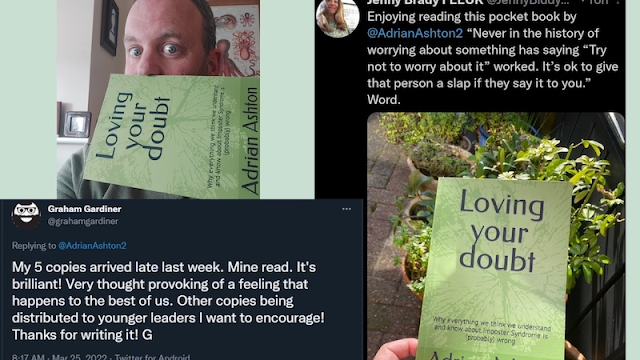
This was, in part, prompted by my openly committing earlier this year to be deliberately seeking to identify the impacts that my book on imposter syndrome is creating - over the last few months, I've started to capture evidences and illustrations of some of the changes that people are experiencing and adopting as a result of engaging with my ideas in the book. This open conversation therefore allowed me an opportunity to reflect with fellow social value and impact practitioners on these emergent practices and approaches to challenge my own thinking to date, and any bias that may be creeping into my 'navel gazing'...

The below summarises what I took from the conversation as encouragement, challenge, and further provocation. It's shared in hopes of helping to continue this conversation, and also capture the insights and ideas shared for the benefit of others:


"Impact should be able to be recognised and celebrated, even if can't be evidenced" - there's often a fervour to capture feedback forms, survey responses, and such like in the rush to prove that good things have happened. But as any good scientist knows, the very act of observing something changes its nature, so sometimes we should be OK with being able to accept and acknowledge impacts on faith, without needing to see reams of data and charts behind the assertion?


"All impact is subjective" - we live in a world of very few moral absolutes: what is important for me is less so for you (think Marmite), so how should we recognise and prioritise the impacts that our words create? To take this idea further - for what purpose are we wanting to understand the impact that our book is creating?  For me, that's actually easy to answer: I never had any intentions to write or publish a book - rather to 'scratch an itch' about an idea, so in the spirit of lifelong learning, I'm genuinely interested to see what it causes. This is because that will ultimately help me better decide if there should be a 2nd edition, a book about something else, or I should hang up my author's quill altogether... 


"Will we still be reading books in 200 years time?" - the impact of books can echo far further into the future than our current ways of considering impact can hope to capture - Charles Dickens wrote books 200 years ago that still speak to us today as encouragement and challenge, as do the works of Shakespeare from 400 years ago... Should we then, at least, hope that the books we write today will still be pertinent to what it means to be human and how we live our lives in the centuries to come?  Unless, that is, we're wanting to create impact around a specific current issue - because if our words work in the way we anticipate they will, then they it will no longer be of relevance or interest beyond the next generation. Which takes us to the next point...


"Why are we writing in the first place?" - what impact are we hoping to create from the books we write? We know that Dickens and Shakespeare, as well as writing for the entertainment of others, sought to use their books as ways to try and influence societal practices and cultures that they felt uncomfortable with. And we know that some writers today are seeking to influence lifestyles and worldviews to mitigate climate damage, and/or help us better think about our relationships with technology. But I wrote my book without any specific intended impact in mind that it would create in others, other than to try and widen conversations people had about feelings of imposterism - as authors, do we need to have a specific intention of how our words will create impact (although it might be easier to track progress against them if we do)?


"Are we wanting to change the reader, or change their world?" - and to extend this idea about the impacts we seek to create in others - are these impacts focussed on the individual who reads the book (in that the changes they subsequently make benefit them), or are they more altruistic in seeking to influence the readers' behaviour so that they will in turn magnify and create benefits primarily for others around them?


"How far should we hold responsibility for what we write?" - but if we talk of intended impacts, we also need to consider unintended impacts: after all, as an author, we can't know or control how what we write will be read by others, understood by them, or selectively referenced to support their own agendas and positions. The way we publish can have some sway in mitigating this (self-publishing means that the authors 'voice' hasn't been edited, censored, or rephrased at the request of an editor), but it doesn't completely resolve it.  


"What's the impact of a slogan?" - how far does the medium and format of written words also influence change in/for people - for example, can slogans on tee-shirts have the same impact on a person's life as a book that they read?


"But what about the author?"  so far, we've considered impact of the book (or similar) on the people who are reading it - what about the impact on the author who writes it? What changes and benefits do they gain through this process (and how far should we be concerned about the benefits gained by this key stakeholder to the book?)


"Be the best stalker you can be" - Whilst the above all prompt further thought and reflection, the conversation also turned to practical matters - if you publish a book, you don't have any automatic way of knowing who's read it or who they've shared it with (outputs); how it's engaged them emotionally, and through that, prompted them to make changes in their circumstances (outcomes); and what changes in their life as a result (impact). This gave rise to some salutary reminders about not over-claiming impacts (after all, we don't know what people have also been engaging with alongside reading our book). Also, that comments people make in reviews about intentions can't be taken as assurance of subsequent changes they'll make in their future behaviours; and how do we even hear about what people are saying and sharing if we're not part of their networks?  


I can't speak (or write!) for the others who were part of the conversation - although I hope that they'll find ways to share with others what they took from this conversation in turn. But for me, I found it a very encouraging and progressive conversation that's given me plenty to keep reflecting on as I continue to seek to understand how proud or shamed I should be by the pocket-book I accidently wrote.

And for anyone wondering if anyone really did join us from their bath - and so qualified for a free copy of my book: hats (or rather, shower-caps) off to Charlotte Osterman of Social Value UK:

Friday, July 29, 2022

Molotov cocktails, jelly babies, onions, and handfuls of sand - how people I work with really see me...

As part of my ongoing CPD*, I commit to an adapted360-degree feedback process on myself every couple of years. But instead of sending out questionnaires or survey forms, I ask people 1 question – this year, that question was

“if there was to be a statue made of me, what would you expect to see it holding in its hand?”


People offered a wide range of accessories, but all seem to relate to two themes:

* My playful nature, and encouragement that we should all try to find more moments of enjoyment in what we do;

* My desire to encourage and support others in their journeys and roles.

This seems to be aptly illustrated by the most commonly referenced items being a fez, and my book on imposter syndrome.


However, there was also a wide of other creative ideas, and I felt it only proper to share these on, to see if people feel these might also be fitting decorations to a form of me:

- lego bricks

- a business award

- Post it notes

- sand (because it represents my being able to hold lots of tiny details which most others can’t retain)

- a light sabre

- jelly babies

- a cup of water (because its essential, life affirming, and bountiful – although personally I’d prefer it to have been a glass of whiskey…)

- weird glasses (to convey my ‘quirkiness’)

- a rubicks cube (which co-incidentally I have a lego version of one)

- a Molotov cocktail (because I make very policy-based subjects incredibly entertaining and, drawing comparison with the revolutionary symbol of the Molotov, I’ve been unafraid to do this by myself for almost 20 years.

- a fedora (don’t worry Tony Robinson, you’ll always be the king of the fedora for me!)

- a sealed envelope with all the answers inside (not for me to give to you, but to encourage you that there are answers that are right for you, and I’ll help you work through things to get to yours in the end)

- someone else’s hand (to illustrate my helping other people)

- an onion (because it has many layers, it has a heart, it has a tough skin, it is essential to most recipes, it represents the coming together of good food and good people, it is versatile, it is important to all sectors of society)


But one person’s response described a vista, that’s making me think that I should be considering a portrait, rather than a statute:

"If there was ever a statue to be made of the coolest consultant in town, I would imagine it would resemble the eternal image I have etched into my hippocampus of Adrian, it would be one of a man wearing a red fez hat standing proudly on top of a really complicated looking but easily assembled lego structure holding a magnifying glass as he examines a thin green book!!....an eccentric who finds solutions to the most complicated of conundrums with supernatural attention to detail, the man the myth the legend that is Adrian Ashton"


And the idea of a portrait might also help resolve another conundrum about my being ‘statue-d’ I’d not considered: someone asked what it would be cast in: gilt, marble, iron or papier mâché; and if it would be life size or larger than life?


*CPD = not what you think it stands for...

Thursday, July 28, 2022

Tell us more... being interviewed about Imposter Syndrome

 this post first appeared on the Freelance Heroes blog - for similar interviews with freelancers about other aspects and shared lived experiences of freelancing, please check them out! 

https://freelance-heroes.com/blog/ 


Imposter syndrome is a topic we often hear discussed not only in the freelance community but with many types of work and profession. So when Freelance Heroes member Adrian Ashton wrote a book on the subject called ‘Loving your doubt: Why everything we think we understand and know about Imposter Syndrome is (probably) wrong‘ we decided we had to delve a bit deeper and hear directly why Adrian chose this subject, what we can learn about it, and maybe how to view it a little differently.


Freelance Heroes: Imposter syndrome is a HUGE topic in the freelance world. What was your main motivation/driver for challenging our views and behaviours around this subject?

Adrian Ashton: As with everything I do, I try and be informed and led by evidence and research.

And when I realised that the evidence and research about imposter syndrome actually contradicts everything we’re usually told about this issue, and as a result people are living less complete lives than they might be, how can I not speak out to challenge ‘accepted wisdom’ that turns out to be wrong?


Freelance Heroes: Do you feel that imposter syndrome affects women more than men? Why?

Adrian Ashton: Imposter Syndrome isn’t exclusively for women – but women seem to talk about it more than men (think about any panels or blogs you’ve seen on the subject: they’re all usually by women speaking to/writing for other women).

Research shows that men are just as likely to feel ‘the gremlin of self-doubt’ as women, but perhaps it’s because of cultural norms in our society that men don’t feel able to be as open about it – and perhaps it’s also because when Imposter Syndrome was originally ‘discovered’ it was deemed to only affect women in managerial roles…


Freelance Heroes: I understand that you attended a seminar where the topic of conversation made you stop, start researching, and turn your thoughts and writing into `loving your doubt,` a pocketbook that really makes you think. What specifically started this process?

Adrian Ashton: It was Freelance Heroes Day 2020, when one of the speakers made a passing remark about how as freelancers we all need to get rid of our imposter syndrome, otherwise we’ll never succeed in anything (or something like that).

That’s quite a potent statement, and they offered no follow-up or qualification it – I’m happy to admit that at the time I was still feeling like an imposter, but yet still seemed to be achieving success in lots of areas, so it got be wondering about what it was that I was mis-understanding or had missed about imposter syndrome

Usually, I work out my ideas through drafting a blog post, but the subject matter was getting bigger as I poked it further, and I also wanted to test what I was discovering through my researches by speaking with different people.

All of these people seemed very excited when I shared my ideas and workings out with them, and all of whom encouraged me to publish it as a book for the benefit of others.


Freelance Heroes: Not giving away too much from the book, but why shouldn’t we be afraid of imposter syndrome?  And what surprised you the most?

Adrian Ashton: Having a degree of self-doubt is an evolutionary lay-over that can help us avoid taking risks that are too great: a safety values for times when our confidence may be greater than our actual competence (for example  although people will sing songs about you for years to come for doing so, maybe you should think twice about taking on that pride of lions single handed with only a pointy stick?); and in a more contemporary context, helps us avoid becoming complacent and allowing our competitors overtaking us as a result (how many of the companies listed in the FTSE100 index 10 years ago are still around today?).

And in terms of ‘being surprised’ as I did my research into this topic:

1) How recently imposter syndrome has been a recognised ‘thing’ (1978 was when it was officially ‘discovered’, although people have talked about the feelings associated with it far before then – including Albert Einstein!);

2) How none of the remedies or practices to manage or mitigate imposter syndrome seem to have been subject to any evaluations or research to establish their efficacy or relevance – that’s akin to being prescribed medicines by your doctor, or offered over the counter pills by your pharmacist, that have never been through any clinical trial to make sure they’ll work, and more importantly not accidentally kill you!


Freelance Heroes: How did changing your mindset about imposter syndrome work for you? And is there anything you would do differently in your career, knowing what you know now?

Adrian Ashton: I definitely feel more confident in my abilities since delving into this subject, and realising that actually, feeling like an imposter is a perfectly human and natural state –it’s only when we allow it to limit our relationships with other people that it becomes a problem.

As to the impact that having this insight and realisation sooner might have had on my career – I’ve never felt I’ve had a career: more a series of occasionally linked adventures… I’d still have done the things I’ve done, but I’d have done them sooner.


Freelance Heroes: What would be your parting advice to our Freelance Hero members?

Adrian Ashton: I’d paraphrase The Streets, Oscar Wilde, and my mum:

None of us are getting out of this life alive; so, try everything once apart from murder, incest, and Morris dancing; and remember that good manners can always get you further than you think they will…


Loving your doubt: Why everything we think we understand and know about Imposter Syndrome is (probably) wrong‘ is available to BUY NOW and is also featured in our Members Library alongside other contributions from our members.

Monday, July 4, 2022

playing statues

As a freelancer, I've evolved my business model in some unusual ways over the years, and one of these practices is seeking feedback from clients, collaborators, (and other people beginning with the letter 'C') - but not perhaps in the way that's traditionally done...

This means that rather than ask people to tick some boxes on a survey form, or rank me on scales, I ask a simple question.

For previous versions of this question, scroll back through previous blog posts, but this year, I'm wondering - "If there was to be a statue made of me, what would you expect to see me holding in my hand?"


Happy to take answers and suggestions by your posting replies to this blog, messaging me direct, or through any of the social media channels you can find me on.

I'll be collating all the responses at the start of August, and will share then what the accessories are that I'll be posing with for my for my future casting...