Friday, July 29, 2022

Molotov cocktails, jelly babies, onions, and handfuls of sand - how people I work with really see me...

As part of my ongoing CPD*, I commit to an adapted360-degree feedback process on myself every couple of years. But instead of sending out questionnaires or survey forms, I ask people 1 question – this year, that question was

“if there was to be a statue made of me, what would you expect to see it holding in its hand?”


People offered a wide range of accessories, but all seem to relate to two themes:

* My playful nature, and encouragement that we should all try to find more moments of enjoyment in what we do;

* My desire to encourage and support others in their journeys and roles.

This seems to be aptly illustrated by the most commonly referenced items being a fez, and my book on imposter syndrome.


However, there was also a wide of other creative ideas, and I felt it only proper to share these on, to see if people feel these might also be fitting decorations to a form of me:

- lego bricks

- a business award

- Post it notes

- sand (because it represents my being able to hold lots of tiny details which most others can’t retain)

- a light sabre

- jelly babies

- a cup of water (because its essential, life affirming, and bountiful – although personally I’d prefer it to have been a glass of whiskey…)

- weird glasses (to convey my ‘quirkiness’)

- a rubicks cube (which co-incidentally I have a lego version of one)

- a Molotov cocktail (because I make very policy-based subjects incredibly entertaining and, drawing comparison with the revolutionary symbol of the Molotov, I’ve been unafraid to do this by myself for almost 20 years.

- a fedora (don’t worry Tony Robinson, you’ll always be the king of the fedora for me!)

- a sealed envelope with all the answers inside (not for me to give to you, but to encourage you that there are answers that are right for you, and I’ll help you work through things to get to yours in the end)

- someone else’s hand (to illustrate my helping other people)

- an onion (because it has many layers, it has a heart, it has a tough skin, it is essential to most recipes, it represents the coming together of good food and good people, it is versatile, it is important to all sectors of society)


But one person’s response described a vista, that’s making me think that I should be considering a portrait, rather than a statute:

"If there was ever a statue to be made of the coolest consultant in town, I would imagine it would resemble the eternal image I have etched into my hippocampus of Adrian, it would be one of a man wearing a red fez hat standing proudly on top of a really complicated looking but easily assembled lego structure holding a magnifying glass as he examines a thin green book!!....an eccentric who finds solutions to the most complicated of conundrums with supernatural attention to detail, the man the myth the legend that is Adrian Ashton"


And the idea of a portrait might also help resolve another conundrum about my being ‘statue-d’ I’d not considered: someone asked what it would be cast in: gilt, marble, iron or papier mâché; and if it would be life size or larger than life?


*CPD = not what you think it stands for...

Thursday, July 28, 2022

Tell us more... being interviewed about Imposter Syndrome

 this post first appeared on the Freelance Heroes blog - for similar interviews with freelancers about other aspects and shared lived experiences of freelancing, please check them out! 

https://freelance-heroes.com/blog/ 


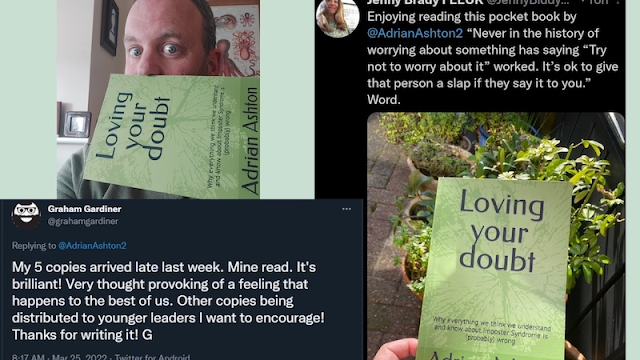
Imposter syndrome is a topic we often hear discussed not only in the freelance community but with many types of work and profession. So when Freelance Heroes member Adrian Ashton wrote a book on the subject called ‘Loving your doubt: Why everything we think we understand and know about Imposter Syndrome is (probably) wrong‘ we decided we had to delve a bit deeper and hear directly why Adrian chose this subject, what we can learn about it, and maybe how to view it a little differently.


Freelance Heroes: Imposter syndrome is a HUGE topic in the freelance world. What was your main motivation/driver for challenging our views and behaviours around this subject?

Adrian Ashton: As with everything I do, I try and be informed and led by evidence and research.

And when I realised that the evidence and research about imposter syndrome actually contradicts everything we’re usually told about this issue, and as a result people are living less complete lives than they might be, how can I not speak out to challenge ‘accepted wisdom’ that turns out to be wrong?


Freelance Heroes: Do you feel that imposter syndrome affects women more than men? Why?

Adrian Ashton: Imposter Syndrome isn’t exclusively for women – but women seem to talk about it more than men (think about any panels or blogs you’ve seen on the subject: they’re all usually by women speaking to/writing for other women).

Research shows that men are just as likely to feel ‘the gremlin of self-doubt’ as women, but perhaps it’s because of cultural norms in our society that men don’t feel able to be as open about it – and perhaps it’s also because when Imposter Syndrome was originally ‘discovered’ it was deemed to only affect women in managerial roles…


Freelance Heroes: I understand that you attended a seminar where the topic of conversation made you stop, start researching, and turn your thoughts and writing into `loving your doubt,` a pocketbook that really makes you think. What specifically started this process?

Adrian Ashton: It was Freelance Heroes Day 2020, when one of the speakers made a passing remark about how as freelancers we all need to get rid of our imposter syndrome, otherwise we’ll never succeed in anything (or something like that).

That’s quite a potent statement, and they offered no follow-up or qualification it – I’m happy to admit that at the time I was still feeling like an imposter, but yet still seemed to be achieving success in lots of areas, so it got be wondering about what it was that I was mis-understanding or had missed about imposter syndrome

Usually, I work out my ideas through drafting a blog post, but the subject matter was getting bigger as I poked it further, and I also wanted to test what I was discovering through my researches by speaking with different people.

All of these people seemed very excited when I shared my ideas and workings out with them, and all of whom encouraged me to publish it as a book for the benefit of others.


Freelance Heroes: Not giving away too much from the book, but why shouldn’t we be afraid of imposter syndrome?  And what surprised you the most?

Adrian Ashton: Having a degree of self-doubt is an evolutionary lay-over that can help us avoid taking risks that are too great: a safety values for times when our confidence may be greater than our actual competence (for example  although people will sing songs about you for years to come for doing so, maybe you should think twice about taking on that pride of lions single handed with only a pointy stick?); and in a more contemporary context, helps us avoid becoming complacent and allowing our competitors overtaking us as a result (how many of the companies listed in the FTSE100 index 10 years ago are still around today?).

And in terms of ‘being surprised’ as I did my research into this topic:

1) How recently imposter syndrome has been a recognised ‘thing’ (1978 was when it was officially ‘discovered’, although people have talked about the feelings associated with it far before then – including Albert Einstein!);

2) How none of the remedies or practices to manage or mitigate imposter syndrome seem to have been subject to any evaluations or research to establish their efficacy or relevance – that’s akin to being prescribed medicines by your doctor, or offered over the counter pills by your pharmacist, that have never been through any clinical trial to make sure they’ll work, and more importantly not accidentally kill you!


Freelance Heroes: How did changing your mindset about imposter syndrome work for you? And is there anything you would do differently in your career, knowing what you know now?

Adrian Ashton: I definitely feel more confident in my abilities since delving into this subject, and realising that actually, feeling like an imposter is a perfectly human and natural state –it’s only when we allow it to limit our relationships with other people that it becomes a problem.

As to the impact that having this insight and realisation sooner might have had on my career – I’ve never felt I’ve had a career: more a series of occasionally linked adventures… I’d still have done the things I’ve done, but I’d have done them sooner.


Freelance Heroes: What would be your parting advice to our Freelance Hero members?

Adrian Ashton: I’d paraphrase The Streets, Oscar Wilde, and my mum:

None of us are getting out of this life alive; so, try everything once apart from murder, incest, and Morris dancing; and remember that good manners can always get you further than you think they will…


Loving your doubt: Why everything we think we understand and know about Imposter Syndrome is (probably) wrong‘ is available to BUY NOW and is also featured in our Members Library alongside other contributions from our members.

Monday, July 4, 2022

playing statues

As a freelancer, I've evolved my business model in some unusual ways over the years, and one of these practices is seeking feedback from clients, collaborators, (and other people beginning with the letter 'C') - but not perhaps in the way that's traditionally done...

This means that rather than ask people to tick some boxes on a survey form, or rank me on scales, I ask a simple question.

For previous versions of this question, scroll back through previous blog posts, but this year, I'm wondering - "If there was to be a statue made of me, what would you expect to see me holding in my hand?"


Happy to take answers and suggestions by your posting replies to this blog, messaging me direct, or through any of the social media channels you can find me on.

I'll be collating all the responses at the start of August, and will share then what the accessories are that I'll be posing with for my for my future casting...

Wednesday, June 15, 2022

facilitating with watermelons and carrots as an imposter

I was recently invited to share and facilitate discussions with a forum of global facilitators about how imposter syndrome impacts them personally, their professional practices, and the implications that this has for their clients in turn.


This was as part of the ongoing Facilitation Lab series, so it felt very much like being a visiting scientist who'd been asked to share exciting new experiments, and play with test tubes and bunsen burners! (safety goggles at the ready...)


Somehow, I found that within the 90 minutes scheduled, I only talked about my book about imposter syndrome (the reason I'd been invited to lead the session) for about 60 seconds - but the wider conversations I encouraged people to share together seemed to offered them far more value, than listening to me lecture them about my book would have done; (at least, that's how it seemed from my side of the screen).


Most admitted to being afflicted by imposter syndrome at times as facilitators (and interestingly, this didn't seem to be something which reduced with how long they'd been doing it for). In turn, this led to people sharing impacts that ranged from not seeking work they saw advertised; not being able to charge what they know they should for their services; and experiencing disrupted health - but that's perhaps not that untypical across most professional practices?

However, the ways in which people then shared with each other how they seek to mitigate or manage these impacts and feelings revealed some very unexpected practices:

- promising oneself a massive chocolate bar once they've got through the session with the client, to help them retain their resolve;

- practicing self-awareness about personal biases and prejudices;

- spontaneous prayer;

- accepting that despite best plans and efforts, there will always be at least one thing will go wrong;

- and realising that as a facilitator, we're always going to be the 'odd one out' in any group: we stand apart from everyone else in not being part of, or sharing, the norms and cultures they've already formed as a working team. And that in itself would usually be basis enough to make us feel that we're an imposter in being the 'outsider' - but as a facilitator that's what we're supposed to be!


And it's also the closing reflections that people shared with each other on how the whole lab session felt to them: summing up how the conversations, stories shared, and practices that will now be being introduced into their respective professional practices. As we went around the zoom boxes, people shared how they'd felt the time for them had been like roast beef / watermelon / lentil loaf / carrots / a continental breakfast / spaghetti...   


(and if you want to know about the book that prompted FacLab to ask me to guest lead this session: https://www.amazon.co.uk/dp/B09V25N8G6

Tuesday, June 14, 2022

how the tax system unfairly disadvantages smaller businesses (like mine)

As a non-VAT registered business (like half of all the other business registered in the UK), I can't reclaim the tax I'm charged by my suppliers on my running costs (utilities, marketing, insurances, equipment, etc).

This means my overheads and running costs are up to 20% higher than they might be otherwise if I were - and puts me at an unfair financial disadvantage against other firms who are VAT-registered (because they don't have to cover costs in the same way I do, in their being up to 20% lower...).


So, I hear you reasonably ask, why don't I simply register for VAT and stop griping about this?


The answer, I'm afraid, is that if I did I would likely price myself out of being able to win a lot of the work I currently do with smaller charities, community businesses, social enterprises, and the like: once VAT registered I would be legally required to pay the government up to 20% of all the fees I received from clients and customers (before costs) - so to avoid bankrupting myself, this means I'd need to add this additional amount to the invoices I generate. And as most of these groups in turn aren't VAT registered themselves, this means that they suddenly wouldn't be able to afford me: my price would be going up 20% overnight - but I wouldn't be benefitting from any of that additional fee, in having to pass it straight back to the government...

And is that fair? Well, at the time of this blog, there's increasing outcry about the rising cost of petrol and diesel - but as part of this, no-one seems to be pointing out that at least half of what we pay for this commodity is actually tax imposed by the government....


Tax is an emotive issue - many people seem to want to avoid paying as much of it as they can, and there are whole industries that exist to this end (for example, did you know that contracts awarded by the government in recent years have been to companies who've knowingly evaded paying nearly £20BILLION that should have been due in taxes?)

Some people feel that they're justified in this stance because they don't trust how the government uses the monies we pay in tax. And whilst I do have sympathy with this, governments change over time. My own position is that I want to try and be as consistent and honest with myself as I can, and so in tax, as with so many other things, I seem to go against 'accepted wisdom', in that I'm always making conscious decisions to increase my tax liability wherever I can... 

https://thirdsectorexpert.blogspot.com/2015/11/bonkers-why-im-staying-as-sole-trader.html


So whilst this post may have started off as a whine about VAT, now you're reaching its conclusion you'll hopefully realise that it's actually about trying to encourage us to have a wider and more grown up debate about tax than we might usually...

Monday, June 6, 2022

I changed my mind about kindle-ing my book

Earlier this year, I published my first book - on the topic of why everything we think we know about imposter syndrome is (probably) wrong, after I started to look at the research and evidence associated with this issue.

And at the time, I decided to invoke authors prerogative, and only make it available as a physical book - and as part of my sharing the why and how I'd come to accidentally write this book and put it out into the world, I also shared my reasons for this choice.

However, as some may recall, I've shared in previous blog posts how I'm always open to 'being proved wrong' - and this foray into the world of being a published author is no different.

Since the book went 'live', I've had a couple of people ask about an eBook/Kindle version - and I've always politely referred them to the blog post giving the reasons why it was only available in physical form.

But then someone challenged me on this with actual evidence and arguments. And given this is my first time in book publishing land, and I'm largely feeling my way as I go along, they were things which I'd honestly not considered in my original thinking (accessibility issues, import taxes between countries, potential for climate impact, and more opportunity for spontaneity).

So, I've 'relented' and made a copy of the book available as a kindle eBook. 


The reason it's the same price as the physical copy remains true to my original thinking about what to price it at, and I've also allowed for it to be shared between people in the same way you can if you buy a physical copy.

So, if there's moral to this story, it's probably that you should always reach out to authors if they've not done something that you might have preferred/like them to; and that Suzanne Whitby is really good at challenging your thinking (it was her arguments that finally 'tipped me' over to the eBook side...) 


http://thirdsectorexpert.blogspot.com/2022/03/i-did-book-thing.html

https://thirdsectorexpert.blogspot.com/2011/11/its-great-to-be-proved-wrong-really.html 

https://www.amazon.co.uk/dp/B09V25N8G6

Thursday, June 2, 2022

maybe I am ok with being a 'guru' after all...

10 years ago, I publicly posted in a deliberate attempt to distance and separate myself from the title of 'guru' that others were (and still are) referring to me in association with, for my work with enterprises, charities, businesses, sector bodies, and educational institutions of all types - https://thirdsectorexpert.blogspot.com/2012/07/on-being-guru.html

However, a recent conversation prompted my revisiting my understanding and definitions of the word "guru", and I've now come to associate this title with a person who's a popular expert / influential teacher. And on this basis, I now feel comfortable to 'don the mantle' of being a guru: 

  • I'm happy to be known as an expert and teacher (after all, those are the bases on which I 'sell myself', and people extol my virtues through posts on social media and recommendations left on my LinkedIn profile);
  • similarly, based on comments people make about me, and the followings I seem to have amassed across different social media channels, I would seem to have garnered a degree of popularity (although I never meant to!);
  • and I also know my work has changed policy, legislation, created jobs for others; so I can say with confidence that I've had influence.

So - I'm now ok if you want to call me a guru, but my next question to figure out, is what am I a guru of...?