Monday, June 6, 2022

I changed my mind about kindle-ing my book

Earlier this year, I published my first book - on the topic of why everything we think we know about imposter syndrome is (probably) wrong, after I started to look at the research and evidence associated with this issue.

And at the time, I decided to invoke authors prerogative, and only make it available as a physical book - and as part of my sharing the why and how I'd come to accidentally write this book and put it out into the world, I also shared my reasons for this choice.

However, as some may recall, I've shared in previous blog posts how I'm always open to 'being proved wrong' - and this foray into the world of being a published author is no different.

Since the book went 'live', I've had a couple of people ask about an eBook/Kindle version - and I've always politely referred them to the blog post giving the reasons why it was only available in physical form.

But then someone challenged me on this with actual evidence and arguments. And given this is my first time in book publishing land, and I'm largely feeling my way as I go along, they were things which I'd honestly not considered in my original thinking (accessibility issues, import taxes between countries, potential for climate impact, and more opportunity for spontaneity).

So, I've 'relented' and made a copy of the book available as a kindle eBook. 


The reason it's the same price as the physical copy remains true to my original thinking about what to price it at, and I've also allowed for it to be shared between people in the same way you can if you buy a physical copy.

So, if there's moral to this story, it's probably that you should always reach out to authors if they've not done something that you might have preferred/like them to; and that Suzanne Whitby is really good at challenging your thinking (it was her arguments that finally 'tipped me' over to the eBook side...) 


http://thirdsectorexpert.blogspot.com/2022/03/i-did-book-thing.html

https://thirdsectorexpert.blogspot.com/2011/11/its-great-to-be-proved-wrong-really.html 

https://www.amazon.co.uk/dp/B09V25N8G6

Thursday, June 2, 2022

maybe I am ok with being a 'guru' after all...

10 years ago, I publicly posted in a deliberate attempt to distance and separate myself from the title of 'guru' that others were (and still are) referring to me in association with, for my work with enterprises, charities, businesses, sector bodies, and educational institutions of all types - https://thirdsectorexpert.blogspot.com/2012/07/on-being-guru.html

However, a recent conversation prompted my revisiting my understanding and definitions of the word "guru", and I've now come to associate this title with a person who's a popular expert / influential teacher. And on this basis, I now feel comfortable to 'don the mantle' of being a guru: 

  • I'm happy to be known as an expert and teacher (after all, those are the bases on which I 'sell myself', and people extol my virtues through posts on social media and recommendations left on my LinkedIn profile);
  • similarly, based on comments people make about me, and the followings I seem to have amassed across different social media channels, I would seem to have garnered a degree of popularity (although I never meant to!);
  • and I also know my work has changed policy, legislation, created jobs for others; so I can say with confidence that I've had influence.

So - I'm now ok if you want to call me a guru, but my next question to figure out, is what am I a guru of...?


Monday, May 16, 2022

"I couldn't tell who was in the room, and who was on zoom.."

Last weekend, I was part of supporting a hybrid conference - which was about how we 'do' hybrid (hope that's not too meta of a concept to open a blog post with?)


As a facilitator who's part of the IAF England & Wales team, earlier this year we were considering how to re-assert ourselves as a body of practitioners, and also re-spark our community of facilitators, after being without our customary annual conference for the last 2 years (Covid, and all that). 
Someone (possibly me) suggested that we do it as a hybrid event - giving us the chance to share, try out, and learn from others how we do events where people are both 'roomies' and 'zoomies'. 

And while there's lots of other posts people are making about their experiences of it across social media, expressing how having it as hybrid was far more enjoyable and engaging than many were fearful it would be otherwise, I wanted to pause to reflect on my experience of leading a session about how we do networking in hybrid ways.

Given that we all know (in theory) how to do networking in person, and we've started to feel our way with it on-line in breakout rooms, etc over the last 2 years of pandemic, I wanted to try out the notion of doing it 'hybrid' - where the people networking together are both on-line and in a room at the same time.


I also wanted to explore some of what each side felt like they were missing out on, in not being in the others' physical/virtual space. 
So, as part of the session, I posed a flipped question to both groups - what did zoomies feel they were missing out on, by not being in the room; and what did the roomies feel they were missing out on by not being a zoomie.

Interesting, there were lots of frustrations and FOMOs expressed on both sides, but in 'headline':

- if you're on-line in a hybrid event, you miss the spontaneity and potential for physical contact with other human beings;

- if you're in the room at a hybrid event, you can feel more vulnerable and at risk from not having access to your usual home comforts, and having less recourse to being able to 'get out' if you feel they need to.


So - some good learning that highlights that not everyone is keen to rush back to doing everything in person (or if we are, we need some careful considerations). 
And there was also lots of other great learning throughout the conference about the realities and practicalities of both managing, and being part of, hybrid events.
(SPOILER: despite our not spending any money on tech, and the venue not being set up for hybrid, we managed to lash-up makeshift roving cameras and mics in ways that impressed everyone both on and off line, showing that it doesn't have to be that technically difficult).

But for me, the key message from my session wasn't about how to run hybrid networking in a tech way, but in how I approached it as a facilitator in recognising that there were 2 groups of people with different different starting/engagement points.
Encouragingly, how I planned the session and facilitated the networking seemed to work really well for people, with comments being made afterwards such as:

- "this experience has made me more confident about doing things in a hybrid way"

- "when we were doing the networking, I hadn't realised who was in the room/on zoom until afterwards!"

So for anyone who's either planning, or thinking about being part of, a hybrid event - my takeaway would be this: as important as it is to get the tech doing the things you need/want it to, it's just as important to also think and plan how you're going to structure the sessions and activities within it to help everyone feel part of it, regardless of how they're joining it.


Thursday, May 12, 2022

why, as a freelancer I'm paying to offset my carbon footprint

My recently published impact report on myself introduced something new for the first time in the 16 years I've been doing it - commitments and targets to revisit and report against in next years (which will be due sometime in April 2023: watch out for the #AAimpact23 tag!).

Around this time I've also been leading a bootcamp for businesses who were wanting to do more around their environmental impact. And whilst they all started that journey thinking it would be the carbon footprint of their products, they all started to realise that in some instances the way that they ran their businesses was having a biggest cost to the environment than what they were selling to their customers.

And these two things came together around one of the KPIs in my impact reporting framework (which has also been one of the first measures I started using all those years ago...) - trying to consider my impact on the natural environment by tracking how far I've been able to avoid needing to make journeys 'in physical person', and so avoiding adding pollution from not needing to burn the fossil fuels that go into the petrol tank of a car, and the diesel for a train.

I've reflected on one of the unexpected outcomes of this practices and indicator in a previous blog - but I've caught myself increasingly asking 'so what?', against this measure: what's the point of measuring something if we don't do anything with the number it gives us (other than stroking our ego and vanity)?

So to this end, I've decided to use this metric to help me calculate the carbon footprint I'm creating when I can't avoid having to make physical travel to a client to deliver workshops, facilitate meetings, and such like. And with that tonnage figure, I'm then going to offset the carbon I've created by purchasing 'carbon credits' that can be used to invest in different projects and initiatives to try and 'rebalance the scales'.


But even now - so what? I'm a sole trader, and it's unlikely that the carbon footprint I generate from business travel will amount to anything remotely approaching significance in the context of other business'; and by association, what I'll pay to rebalance it will seem paltry in a global scale. So why should I bother? It'll only cost me more as a business, and won't have any meaningful impact on the environment.

The point, dear reader, is this - if we don't each take a stand and start to model the behaviours that we want to try and encourage and challenge others over in seeing a better world come about, then what credibility do we have to bemoan the state of the world? If we don't 'walk the talk', why should anyone else? And ultimately, if we resign ourselves to the mindset of "I'm too small to make any meaningful difference", just remember what's possible when 1 person stands up - it can inspire others to do the same, and so sooner or later, change happens. 

So in hopes of encouraging and challenging others in this endeavour, I'm going to start adding a rider to my client invoices and proposals: "any physical travel involved in the delivery of this work has been carbon offset at my cost as part of my commitment to helping to sustain our world for ourselves and future generations."  


Wednesday, May 4, 2022

why are the new wave of start-ups being called the purpose-led ones, when they aren't?

I'm not sure if it's because of the types of circles I usually find myself moving in, or the bias of how stories are reported in the media, or because there really is a general sense of it, but it seems that we're in a period when most new start-ups are being referred to having 'purpose' (and more so than existing/previous waves of start-ups)?


If this is really true, then I'm wondering where are all these new businesses who apparently are motivated by their values and wanting to create impact actually are: 

- the most commonly googled questions by entrepreneurs and people starting up their business include NOTHING about purpose, impact, values, etc (see https://www.hitachicapital.co.uk/business-finance/invoice-finance/invoice-finance-blog/the-most-common-questions-startup-owners-ask-google/)

- and the most frequent search by type of business offer being started is for clothing. And whilst I agree that there are some needed and 'proper' things happening in this industry (labour behind the label, for example), this is an industry that's also strongly associated with a plethora of negative impacts (the cost of 'fast fashion', etc)


So, based on the data from the biggest search engine in the world, these new waves of 'purpose-led start-ups' maybe aren't as prevalent as is being otherwise suggested to us.

Or maybe they're simply not using google to do the research they need to launch their new ventures like the rest of us do?

Monday, April 25, 2022

this year, I'm not giving anything away about what my social impact report shows about me.

Some will recall that around this time every year, I openly publish my annual social impact report on myself - previous years' blogs have expounded on the reasons I do this, and these posts are also where I critically reflect on a specific aspect of the report's findings that I feel is of particular relevance to me, and where I'm 'at' professionally at that time.


But this year is different.


The report is still published as usual, but the critical reflection on what it finds is instead all contained within it.


So what are you still doing here? Follow the link and go dive into this years #AAimpact22 - with extra photos, illustrations, and more KPIs than ever before...

https://drive.google.com/file/d/1uMqydPRDQww0tPY0k6i54G9itx2oLnDj/view?usp=sharing


Wednesday, April 13, 2022

social enterprise legal structures for humans

Some people regard me as an expert authority on legal and governance forms for social enterprise, community businesses, and co-operatives - and while I always encourage people not to trust any guidance I offer them on this topic (because I'm not academically accredited in legal stuff, and more importantly because I'm not the one who's going to be legally responsible for administering the chosen form), people take encouragement from my achievements in changing company law, navigating Society Rules with the FCA, and finding paths through charity legislation.

Over the decades that I've been supporting people understand these choices, I've created a few tools/prompts to help focus discussions and reflections ('CHAMP' and 'Adrian's 4-boxes') - but this post isn't about those tools - instead it's about a 3-part limited youtube series I was invited to be part of the 'main cast' for.


A contact through one of my networks had approached me to ask if I could help them explore and understand what the best legal form for a new social enterprise they were developing might be. And as we talked about how I might offer guidance and assistance, we hit on the idea of making this a 'performance piece' - drawing back the curtain on how people usually go through this process as an encouragement to the wider sector, and also a working out of some of their (and the emerging enterprises') values.
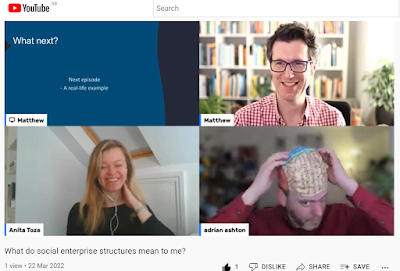
So we scheduled 3 afternoons to talk though approaches to not only understanding why this legal form question is so important to get right, but the different ways we can pick and choose between them, and finally, applying all of this learning in real time/live to their nascent social enterprise.

There's an 'official' long post on LinkedIn by Matthew Bellringer (the contact that sparked this) where you can get the official story of how this series came to be: https://www.linkedin.com/pulse/foundations-thriving-social-enterprise-matthew-bellringer/ but I wanted to take the opportunity to reflect on how I found this process, in it being different to the ways in which I usually offer this type of support - to pull out what surprised me that I hadn't considered before, what was an encouragement in allowing more time and space to explore than is usually available, and some of the things which you don't normally hear or read about in this area.


So - the below points are what I think are useful framing/warm-up for anyone thinking of approaching either choosing or reviewing a legal or structural form for their social enterprise - if you want to know more about them, you'll have to follow the links to youtube and watch all 3 episodes...

- Comparing legal structures to buying second-hand car: you wouldn't buy a car without wanting to know some of its history to assure you that it's been built well, and looked after, so why don't we seek the same assurances when deciding between legal forms?

- The risks of using data that maps legal forms used by social enterprise in helping us choose one for our own: as part of the episodes, we looked at research into how far different legal forms are popular/less popular by the wider social enterprise sector. But as you'll see as you watch this segment, this mapping - as undertaken by national sector bodies, often presents a contradictory picture of findings. As with all research, what you find depends on how you ask the question, and whom you ask it of. And it seems that our sector leaders can sometimes do this in ways that might not seem to be that robust..?  

- None of the existing tools designed to help you plan your social enterprise model (social enterprise canvases, specialist business plan templates, etc) help you relate your ethos and values to the legal form you'll pick. Which seems a bit bonkers, because your chosen legal form is probably one of the best ways you have to make sure said ethos and values can be best protected into the future. That's why I developed my 'CHAMP' framework, which is profiled in detail through these episodes.

- Your legal structure as a social enterprise can influence your credibility to lobby and speak out on social issues. For example, charities and CICs are banned from undertaking political activities: but if we're serious about creating systemic change as a social enterprise, then at some point we have to engage with the policy and law makers (which perversely, our chosen form may actually prevent us from being able to do!).

- The problem with all of the toolkits designed to help making the process of picking a legal form easier is that they assume you understand the jargon, and underlying concepts associated with legal forms and governance. Which most of us don't, which explains why these toolkits are so underutilised by the wider sector.

- There's a confusion about Members, members, and membership, that knots so may people up when approaching social enterprise legal forms: one has legal power over you, one is a supportive friend, and the other is about collective activism that influences your decision making. Can you tell which is which?

- Stickers and badges, or legal power – which would people prefer to have in your social enterprise? And which would you want people to have? (remember that there are wider trends going on in society that means formal membership bodies are generally seeing their numbers start to plateau and decline - people may be more interested in being part of you for specific periods, rather than for life).

- We managed to compress over 400 years of legal structures for social enterprise into just over 10 minutes. A new personal best for me!

- How the regulator for your chosen social enterprise legal form can strengthen others' trust in your venture. None of the toolkits or other materials 'out there' that I come across to help you decide about legal forms ever talk about the regulators: what they can do to you, how they can support and protect you, and how they may influence how others see you. But this is also a far wider issue and problem: I also see it a lot of start-up programmes, where social entrepreneurs are supported and encouraged to start-up and incorporate their ventures, but then given no support in knowing how to 'look after it' with their respective regulator - leading many early stage social enterprises to suffer fines, penalties, and even enforced winding up because no-one explained to them about the regulators... 

- It turns out that knowing how to bake cakes can be very helpful in informing how we approach designing different membership models in social enterprise legal forms.

- Campfire songs can be equally important in the selection of choosing a legal form for a social enterprise.

- and finally - why every social enterprise should be wary of S&M clubs if they’re going to be a CIC.


I've found myself enjoying this process of working with a group to find an answer to a question, and also that it's encouraged us to take more time in how we consider the options and implications - despite doing the whole thing remotely to each other with video calls, etc, it's felt like it's helped to make choosing a legal form a process that's allowed us to be more human. 


Episode 1: what's a social enterprise, and why do I care?  

https://youtu.be/5T7TzanQh0s 

Episode 2: what do social enterprise legal structures mean to me? 

https://youtu.be/EaRRsWPfDK0

Episode 3: social enterprise in the real world. 

https://youtu.be/JmEi3b6f9_g